Getting a new toilet seat should be simple — but walk into any hardware store without the right numbers, and you will quickly realize that not all seats are created equal. The wrong purchase means a wobbly seat, a mismatched shape, or a frustrating return trip. Whether you are upgrading your bathroom or simply replacing a cracked seat, understanding toilet seat dimensions before you buy saves you time, money, and a surprising amount of confusion. This guide walks you through every measurement you need, explains the key differences between seat shapes, and answers the most common questions people have before buying.
How to Measure a Toilet Seat in Three Simple Steps — The Complete Replacement Guide:
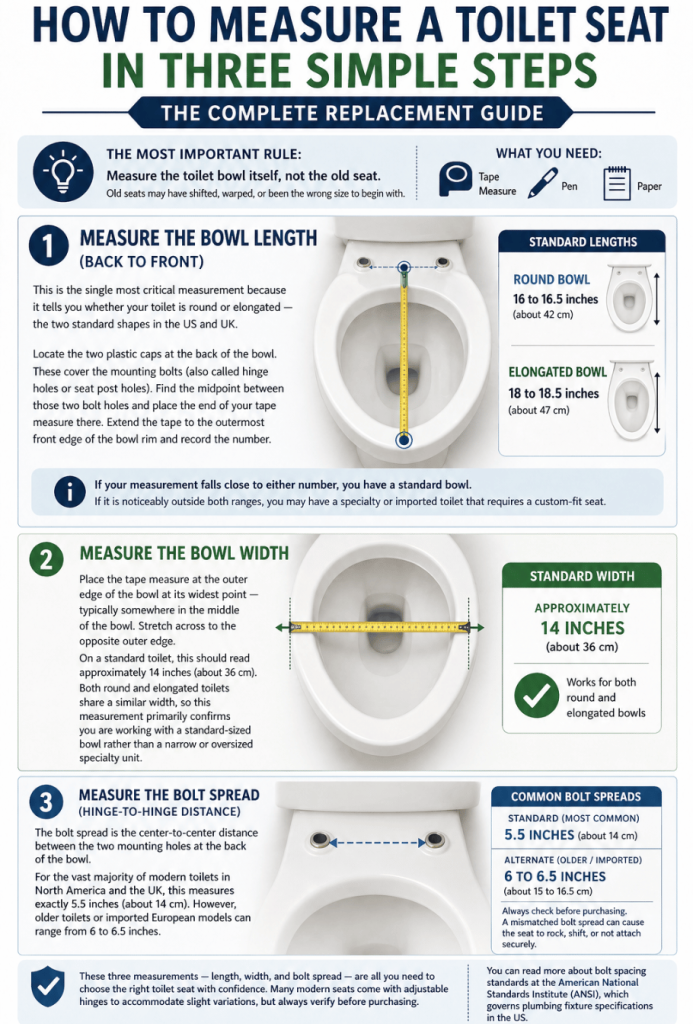
The most important rule before you begin: measure the toilet bowl itself, not the old seat. Old seats may have shifted, warped, or been the wrong size to begin with. Grab a tape measure, a pen, and a piece of paper. You need three numbers.
Step 1 — Measure the Bowl Length (Back to Front):
This is the single most critical measurement because it tells you whether your toilet is round or elongated — the two standard shapes in the US and UK.
Locate the two plastic caps at the back of the bowl. These cover the mounting bolts (also called hinge holes or seat post holes). Find the midpoint between those two bolt holes and place the end of your tape measure there. Extend the tape to the outermost front edge of the bowl rim and record the number.
- Round bowl: approximately 16 to 16.5 inches (about 42 cm)
- Elongated bowl: approximately 18 to 18.5 inches (about 47 cm)
If your measurement falls close to either number, you have a standard bowl. If it is noticeably outside both ranges, you may have a specialty or imported toilet that requires a custom-fit seat.
Step 2 — Measure the Bowl Width:
Place the tape measure at the outer edge of the bowl at its widest point — typically somewhere in the middle of the bowl. Stretch across to the opposite outer edge. On a standard toilet, this should read approximately 14 inches (about 36 cm). Both round and elongated toilets share a similar width, so this measurement primarily confirms you are working with a standard-sized bowl rather than a narrow or oversized specialty unit.
Step 3 — Measure the Bolt Spread (Hinge-to-Hinge Distance):
The bolt spread is the center-to-center distance between the two mounting holes at the back of the bowl. For the vast majority of modern toilets in North America and the UK, this measures exactly 5.5 inches (about 14 cm). However, older toilets or imported European models can range from 6 to 6.5 inches.
This measurement determines whether a seat’s hinge hardware will align properly. Many modern seats come with adjustable hinges to accommodate slight variations, but always verify before purchasing — a mismatched bolt spread leads to a seat that rocks, shifts, or does not attach securely at all. You can read more about bolt spacing standards at the American National Standards Institute (ANSI), which governs plumbing fixture specifications in the US.
Toilet Seat Types by Shape — The Most Important Starting Point:
Before you even pick up a tape measure, it helps to understand the shape categories available. According to the Wikipedia article on toilets, toilet design has evolved significantly by region, which is why shape matters so much when sourcing a replacement.
Round Toilet Seats — Compact and Traditional:
Round toilet bowls are the older, more traditional design. Their shorter front-to-back length makes them well suited to smaller bathrooms. They are still widely found in homes built before the 1980s and remain a common choice for tight bathroom layouts. A round seat typically measures about 16 to 16.5 inches from the bolt midpoint to the front rim.
Elongated Toilet Seats — The Modern Standard:
Elongated bowls have largely replaced round bowls in new residential construction throughout North America. The extended oval shape provides more surface area and better thigh support, which most adults find more comfortable for extended use. At approximately 18 to 18.5 inches in length, elongated seats are now the default style in hotels, airports, and most modern homes.
D-Shaped and Square Toilet Seats — Specialty Designs:
Common in contemporary European bathrooms, D-shaped bowls have a flat back and curved front. Square bowls are even more angular and distinctly modern. Both require seats specifically designed to match their unique profiles. If you have either style, bring photographs and precise measurements when shopping, as off-the-shelf standard seats will not provide a proper fit.
Toilet Seat Dimensions — Standard Reference Numbers at a Glance:
Understanding the reference numbers before you shop prevents confusion at the store. The table below summarizes what most standard toilet seats measure across both common types:
| Measurement | Round Seat | Elongated Seat |
| Bowl Length (bolt midpoint to front rim) | ~16 – 16.5 in | ~18 – 18.5 in |
| Bowl Width (widest point) | ~14 in | ~14 in |
| Bolt Spread (center to center) | ~5.5 in | ~5.5 in |
| Seat Thickness (standard) | 0.75 – 1 in | 0.75 – 1 in |
Comfort-height or padded seats can add up to 2 inches in thickness, which is worth checking if clearance under the tank lid is tight.
How to Tell a Round from an Elongated Bowl Without Measuring:
Sometimes you just need a quick visual check. Viewed from directly above, an elongated bowl is noticeably more oval and pointed at the front, while a round bowl looks more circular and compact. If your home was built after the late 1970s or recently renovated, there is a good chance you have an elongated toilet. Older homes, apartment bathrooms, and compact half-baths are more likely to have round bowls. Still, always confirm with measurements before buying — visual guessing alone can be misleading, particularly with compact elongated models that sit somewhere between the two standard sizes.
Key Mistakes to Avoid When Taking Measurements:
Many replacement seat purchases go wrong not because of the seat itself but because of small measurement errors. Here are the most common pitfalls:
Measuring the old seat instead of the bowl. Seats can shift over time or may have been incorrectly fitted by a previous owner. Always measure the bowl directly.
Measuring to the inner rim rather than the outer edge. Your tape must reach the outermost front edge of the porcelain, not the inner lip of the bowl opening.
Ignoring the bolt spread on older or imported toilets. While 5.5 inches is standard in North America, older American toilets and European imports sometimes use wider spacing. Always verify.
Assuming shape from appearance alone. A toilet can look round but actually be a compact elongated model. Measure first, every time.
Frequently Asked Questions:
Are toilet seats universal — can any seat fit any toilet?
No, toilet seats are not universal. While there are standardized sizing conventions in the US and UK, the exact length, width, shape, and bolt spread can vary by brand, country of manufacture, and toilet age. The two common standard shapes — round and elongated — each require a seat designed for that specific shape. European toilets, older American models, and designer or wall-mounted toilets frequently use non-standard dimensions that require specialty seats. Always measure before purchasing.
Are all toilet seats the same size — even within round or elongated categories?
Not exactly. Within the elongated category, the back-to-front length is consistently around 18.5 inches, which is why most elongated seats are broadly compatible with elongated bowls. However, width, bolt spread, and contour can still differ slightly between brands, especially with high-end or designer toilets. Round toilets similarly conform to a standard length but may vary in other dimensions. Specialty models — particularly imported European or custom-shaped toilets — can fall outside all standard sizing entirely.
Are all elongated toilet seats the same size:
The back-to-front measurement of 18.5 inches is consistent across virtually all elongated toilets, which means most elongated seats will fit most elongated bowls. However, width, tank clearance depth, and hinge hole placement can vary between manufacturers. Bidet seats, for example, require additional clearance behind the bolt holes (usually 1.5–2 inches) because of the electronics housing, so they may not fit every elongated bowl even though the length matches.
What size toilet seat do I need — round or elongated:
Measure from the midpoint between the two bolt holes at the back of your bowl to the outermost front edge of the rim. A measurement of approximately 16 to 16.5 inches means you need a round seat. A measurement of approximately 18 to 18.5 inches means you need an elongated seat. If the number falls outside both ranges, contact the toilet manufacturer or a plumbing supply specialist, as you may have a specialty or non-standard bowl.
How do I measure for a new toilet seat if the old one is already removed:
If the old seat is gone, measure the bowl itself. Place your tape at the center point between the two exposed bolt holes at the back of the bowl and stretch it to the outer front edge of the rim. Measure the width at the widest point and the bolt spread (center to center of the two holes). These three measurements are all you need to find a compatible replacement.
Can I use an elongated seat on a round toilet — or vice versa:
No. Fitting an elongated seat onto a round bowl creates a front overhang that looks wrong, feels unstable, and can cause the seat to crack or bend over time. Using a round seat on an elongated bowl leaves the front of the bowl rim exposed and uncovered, which is both unhygienic and uncomfortable. Adapters exist but are rarely reliable. Always match seat shape to bowl shape. The Family Handyman technical guide on toilet seats strongly advises against mixing shapes.
How do I know if my toilet has a standard or non-standard bolt spread:
Measure the center-to-center distance between the two mounting bolt holes at the back of the bowl. In the US, the ANSI A112.19.2 plumbing standard sets the bolt spread at 5.5 inches for residential toilets. If your measurement differs — particularly if it reads 6 or 6.5 inches — you likely have an older model or an imported toilet. In that case, look for seats with adjustable hinges, which accommodate a range of bolt spacings.
What is the difference in toilet seat dimensions between round and elongated — by the numbers:
Round toilet seats run approximately 16 to 16.5 inches from the bolt midpoint to the front rim. Elongated seats measure approximately 18 to 18.5 inches over the same span. Both share a width of roughly 14 inches and a bolt spread of 5.5 inches. The seat opening on an elongated seat is proportionally larger — approximately 12 by 8 inches — compared to a round seat, which explains why many people find elongated seats more comfortable for everyday use.
Why does my new toilet seat wobble even though I bought the right size:
Wobbling is almost always a bolt-spread issue. If the bolt holes on the seat hinge do not align precisely with your toilet’s mounting holes, the seat will rock. Double-check that your measured bolt spread (center to center) matches the hinge width of the seat. Many seats now include adjustable-width hinges to compensate for minor variations. Also check that the mounting bolts are fully tightened — plastic bolts in particular can feel secure but still allow slight movement if not firmly torqued.
How do I measure a toilet seat that has a D-shape or square design:
For D-shaped bowls, measure the length from the center of the bolt holes to the front edge of the bowl, and the width at the widest point. Also note the shape of the back edge — D-shaped bowls have a noticeably flat rear. For square bowls, measure length, width, and pay close attention to the corner radius. Standard seats will not fit either design. Check with the toilet’s manufacturer directly or refer to the model’s installation documentation, which is often findable on the manufacturer’s website or through resources.
How thick is a standard toilet seat — does seat height matter:
Standard toilet seats are between 0.75 and 1 inch thick. Padded, comfort-height, or feature-heavy seats (such as heated seats with electronics housings) can be up to 2 inches thick. This matters if the toilet tank lid sits close to where the seat hinges mount — a thicker seat could contact the tank when the lid is raised. Measure the clearance behind the bolt holes to the front of the tank before choosing an elevated or oversized seat style.
Should I measure in inches or millimetres for a toilet seat:
In the US, toilet seat dimensions are conventionally listed in inches. If you are buying from a UK or European retailer, measurements are typically given in millimetres. B&Q and other UK home improvement retailers, for instance, advise using millimetres for the most precise measurements. The conversion is straightforward: 1 inch equals approximately 25.4 millimetres. Round toilets are about 419 mm; elongated toilets are about 470 mm from bolt midpoint to front rim.
Can I install a bidet seat on my standard toilet — any extra measurements needed?
Most bidet seats are designed for either round or elongated bowls and follow the same length and bolt-spread standards. However, bidet seats also require 1.5 to 2 inches of clearance behind the mounting bolt holes (between the bolts and the front face of the tank) because the electronic control housing sits in that space. You also need an electrical outlet within reach of the toilet. Verify that clearance measurement and check that your water supply valve is accessible before purchasing. The US Environmental Protection Agency’s WaterSense program provides useful guidance on bathroom fixture compatibility and water efficiency.
What if my toilet measurements do not match either standard size:
If your bowl length does not match either the 16–16.5 inch (round) or 18–18.5 inch (elongated) range, you likely have a specialty or vintage toilet. Wall-mounted toilets installed before the 1980s, some imported European models, and certain high-end designer toilets can use non-standard dimensions. In these cases, contact the toilet manufacturer with your model number or consult a plumbing supply specialist. Custom-fabricated seats are available for most non-standard bowls, though they are typically more expensive and require longer lead times.
How often should I replace my toilet seat — and what signs indicate it is time:
Most toilet seats last between 5 and 10 years under normal residential use, though quality, material, and cleaning habits all affect longevity. Common signs that replacement is overdue include visible cracks or chips in the seat surface (which harbour bacteria and can cause cuts), persistent wobbling that does not resolve after tightening the bolts, discolouration that will not clean off, and hinges that are cracked or no longer hold the seat upright. Lowe’s home improvement guides recommend inspecting hinges and bolt hardware at least once a year as part of routine bathroom maintenance.


Leave a Reply