Choosing the wrong toilet seat might seem like a minor mistake until you are sitting on one that wobbles, overhangs, or simply does not support you the way it should. The elongated toilet seat has become the preferred choice in modern homes, public restrooms, and accessible bathrooms across the country — and for excellent reasons. It offers a more comfortable sitting surface, better hygiene, greater compatibility with accessibility features, and a sleeker aesthetic that suits contemporary bathroom design. Whether you are shopping for yourself, upgrading for an elderly parent, renovating a small bathroom, or simply replacing a worn-out seat, this guide covers everything you need to know — from measuring your bowl correctly to choosing the right materials, weight limits, and hinge types for your specific situation.
Understanding the Elongated Toilet Seat — Dimensions, Standards, and Why Shape Matters:
An elongated toilet seat is oval-shaped and measures approximately 18.5 inches from the center of the mounting bolt holes to the front edge of the bowl. This distinguishes it from a round seat, which measures about 16.5 inches along the same axis — a two-inch difference that significantly affects comfort and fit.
These dimensions are standardized under ANSI/ASME A112.19.2, the American National Standard for ceramic plumbing fixtures, and followed by virtually all major toilet and seat manufacturers in the United States. The bolt hole spacing — the distance between the two mounting holes at the back of the bowl — is standardized at 5.5 inches center-to-center for nearly all North American toilets, so that dimension is consistent across both round and elongated styles.
The seat opening on a standard elongated seat is approximately 12 × 8 inches, compared to about 10 × 8 inches on a round seat. That larger opening, combined with the longer seat surface, provides measurably more thigh support and comfort — particularly for adults, seniors, and individuals with larger frames.
Elongated Toilet Seat vs Round Seat — Choosing What Fits Your Bathroom:
When an Elongated Seat Makes the Most Sense:
Elongated seats are the default choice in most homes built after the 1970s, and in virtually all public and commercial restrooms. According to the International Plumbing Code (IPC) Section 425.2, all water closet bowls in public or employee toilet facilities must be of the elongated type — a legal requirement that reflects the superior hygiene and accessibility characteristics of the elongated bowl design.
For master bathrooms, primary bathrooms, or any space where comfort and accessibility are priorities, the elongated seat is the natural choice. The additional surface area facilitates safer transitions for elderly users, those recovering from hip or knee surgery, and anyone with limited mobility.
When a Round Seat May Be Preferable:
Round seats work well in powder rooms, small half-baths, and any space where floor depth is genuinely limited. However, compact elongated toilet seats — which have an elongated bowl shape but a reduced overall footprint — now offer a practical middle ground for bathrooms where space is tight but comfort cannot be compromised.
Elongated Toilet Seat for Small Bathrooms — The Compact Elongated Solution:
One of the most common misconceptions about elongated seats is that they require significantly more space than round models. While an elongated bowl does extend roughly two inches further from the wall, many manufacturers now produce compact elongated toilet seat options specifically designed to deliver the comfort of an elongated shape within the footprint of a round toilet.
The National Kitchen and Bath Association (NKBA) recommends a minimum of 21 inches of clear floor space in front of the toilet — a guideline that applies to both round and elongated configurations in modern bathroom planning. In bathrooms where this clearance is available, an elongated seat fits comfortably. For truly confined spaces, a slim-profile compact elongated seat can resolve the space concern while retaining the ergonomic advantages of the elongated design.
Ergonomic Elongated Toilet Seat — The Case for Better Body Support:
Why Shape Affects More Than Comfort:
Ergonomics in toilet seat design is not simply a matter of personal preference. The elongated seat shape distributes body weight more evenly across the sitting surface, reducing pressure on the thighs and perineal area during longer sits. For users with chronic conditions such as hemorrhoids, postpartum recovery needs, or post-surgical restrictions, this even weight distribution has meaningful physical benefits.
The longer seat surface also naturally encourages better posture during use — something that has drawn attention from both ergonomics researchers and occupational health professionals who assess bathroom safety for aging populations.
Material Matters Too:
Polypropylene (PP):
The most common seat material. Durable, resistant to most household cleaners, and available across all price points. Offers a consistent, slightly warm feel compared to older thermoset materials.
Thermoset/Urea:
A denser, heavier material with a glossy finish that closely matches vitreous china toilets. More scratch-resistant than PP but typically more expensive.
Wood and MDF:
Traditional wood seats offer natural warmth and a classic aesthetic. MDF-core seats can chip if exposed to prolonged moisture, so look for sealed or high-density options if choosing this material.
Best Elongated Toilet Seat for Adults — What Features to Prioritize:
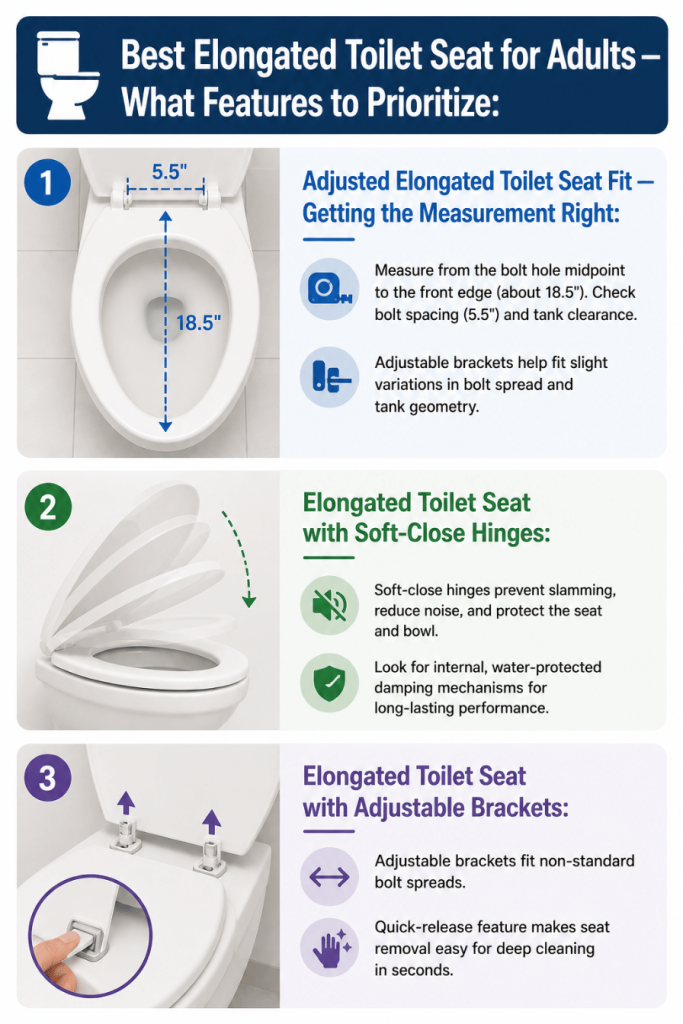
Adjusted Elongated Toilet Seat Fit — Getting the Measurement Right:
Before purchasing any elongated toilet seat, measure your bowl carefully. Place a tape measure at the midpoint between the two mounting bolt holes and extend it in a straight line to the outer front edge of the bowl. A result of approximately 18.5 inches confirms you have an elongated bowl. Also measure the bolt hole spacing (standard is 5.5 inches) and verify the tank clearance behind the bolt holes, particularly if you are considering a bidet-style seat that houses electronics at the rear.
Some elongated seats come with adjustable brackets or flexible hinge posts that accommodate slight variations in bolt spread and tank geometry. These are especially useful for older toilets or non-standard bowl configurations where a fixed-hinge seat may not align correctly.
Elongated Toilet Seat with Soft‑Close Hinges:
Soft-close hinge technology has become one of the most requested features in modern toilet seat upgrades — and for good reason. A soft-close seat descends slowly and silently under its own controlled mechanism, eliminating the sharp noise of a slamming lid. This feature protects both the seat and the porcelain bowl from repeated impact stress, extending the life of both fixtures.
Soft-close hinges use either a hydraulic damper system or a gear-based damping mechanism. When evaluating quality, look for seats where the damping mechanism is internal and protected from water and cleaning products, as exposed mechanisms can degrade faster over time.
Elongated Toilet Seat with Adjustable Brackets:
Seats with adjustable or quick-release mounting brackets solve two common problems simultaneously: they accommodate non-standard bolt spreads, and they make removal for deep cleaning far easier. A seat with a quick-release mechanism allows the entire seat to be unclipped from its hinges in seconds without tools — a practical feature for households where thorough hinge-area cleaning matters.
Elongated Toilet Seat Weight Limit — What You Need to Know:
Standard elongated toilet seats are rated for weight capacities that most manufacturers list between 300 and 500 pounds, depending on the seat construction and hinge material. Seats built from high-density polypropylene with stainless steel or reinforced nylon hinges tend to offer the highest capacities in the standard product range.
For users requiring higher weight support, bariatric or heavy-duty elongated toilet seats are available with rated capacities of 800 to 1,200 pounds. These seats feature wider sitting surfaces, reinforced mounting systems, and hinge assemblies built to handle sustained heavy use. Look for seats with stainless steel hinge bolts rather than plastic, as steel hardware maintains clamping force over time without creeping or loosening under load.
Always check the weight capacity listed in the manufacturer’s specifications — not all seats display this information prominently, but it should be available in the product data sheet or installation manual.
Elongated Toilet Seat for Seniors — Accessibility, Safety, and Independence:
Seniors and individuals with mobility challenges benefit from elongated toilet seats in ways that go beyond simple comfort. The wider seating surface reduces the risk of slipping off the seat during transfers, and the larger bowl opening improves hygiene ease for users with limited reach or flexibility.
ADA‑Friendly Elongated Toilet Seat — Height, Clearance, and Compliance:
The Americans with Disabilities Act (ADA) and the U.S. Access Board establish specific standards for accessible toilet installations. Key requirements include:
- Seat height: 17 to 19 inches from the finished floor to the top of the seat (also called “comfort height” or “chair height”)
- Clear floor space: A minimum 60-inch diameter turning radius in front of the toilet for wheelchair maneuverability
- Grab bars: Side grab bar at least 42 inches long; rear grab bar at least 36 inches long, mounted 33 to 36 inches above the floor
- Flush control: Located on the open side of the toilet, operable with one hand
ADA-compliant toilet seats are almost universally elongated, consistent with the IPC requirement for elongated bowls in public accessible facilities. For residential ADA retrofits, pairing a comfort-height elongated toilet with a properly fitted elongated seat, grab bars on the adjacent wall, and adequate floor clearance covers the core accessibility requirements.
For full guidance on residential ADA bathroom requirements, the U.S. Access Board’s Chapter 6 Technical Guide is the definitive public reference document.
Easy‑Install Elongated Toilet Seat — How to Replace It Yourself:
Replacing an elongated toilet seat is one of the most straightforward DIY home improvement tasks available. Most seat replacements take under 15 minutes with minimal tools.
Tools Required:
- Flathead or Phillips screwdriver
- Adjustable wrench or pliers
- Cleaning cloth or sponge
Step-by-Step Installation:
Step 1 — Remove the old seat: Locate the bolt caps at the rear of the seat, pry or unscrew the covers, and loosen the mounting nuts underneath the bowl rim. Lift the old seat away and clean the mounting area and bolt holes thoroughly.
Step 2 — Position the new seat: Place the new elongated seat over the bowl, aligning the hinge posts with the bolt holes. Ensure the seat sits level and centered across the bowl width.
Step 3 — Secure the mounting hardware: Thread the mounting bolts through the hinge posts and bowl holes. Hand-tighten the nuts underneath, then use a wrench to snug them firmly — avoid overtightening, which can crack the porcelain.
Step 4 — Adjust and test: If the seat has adjustable brackets, fine-tune the fore-and-aft position so the seat front aligns flush with the bowl’s front edge. Open and close the seat and lid to confirm the soft-close mechanism operates smoothly and the seat does not shift laterally.
For further guidance on toilet fixture standards and safe bathroom modification practices, OSHA’s sanitation standards for toilet facilities provide useful context on fixture requirements in both commercial and residential settings.
Frequently Asked Questions:
What is the standard size of an elongated toilet seat?
An elongated toilet seat measures approximately 18.5 inches from the center of the mounting bolt holes to the front outer edge of the bowl. The width across the widest part of the seat is typically 14 to 14.5 inches, and the bolt hole spacing is standardized at 5.5 inches center-to-center for virtually all North American toilets. These dimensions are defined under ANSI/ASME A112.19.2.
How do I know if my toilet is elongated or round?
Measure your toilet bowl from the midpoint between the two rear mounting bolt holes straight to the front outer edge of the bowl. A measurement of approximately 18.5 inches indicates an elongated bowl; approximately 16.5 inches indicates a round bowl. You can also look at the bowl shape from above — elongated bowls are distinctly oval, while round bowls are more circular.
Can I put an elongated toilet seat on a round toilet?
Technically an elongated seat can be placed on a round toilet, but it will overhang the bowl by approximately two inches at the front. This overhang creates a gap that is uncomfortable, unhygienic, and may cause the seat to flex or fail over time. It is always best to match the seat shape to the bowl shape for safety, hygiene, and longevity.
What is the weight limit on a standard elongated toilet seat?
Most standard elongated toilet seats carry weight ratings between 300 and 500 pounds depending on the seat material and hinge construction. Bariatric and heavy-duty models are available with rated capacities of 800 to 1,200 pounds, and feature reinforced seat shells and stainless steel mounting hardware. Always check the manufacturer’s product specification sheet for the confirmed weight rating before purchasing.
What makes an elongated toilet seat ADA-friendly?
ADA-compatible elongated toilet seats work in conjunction with comfort-height toilets that position the seat surface 17 to 19 inches from the finished floor. This height allows wheelchair users and individuals with limited mobility to transfer more safely and independently. The elongated bowl shape itself is preferred by ADA and IPC standards for accessible facilities because of its superior support surface and hygiene characteristics.
Are elongated toilet seats good for seniors?
Elongated toilet seats are an excellent choice for seniors. The larger seating surface reduces the risk of slipping during transfers, the wider bowl opening improves hygiene ease for users with limited reach, and when paired with a comfort-height toilet, the seat height significantly reduces the joint strain of sitting down and standing up. Adding ADA-compliant grab bars to the adjacent wall further enhances safety.
What are soft-close hinges on an elongated toilet seat and are they worth it?
Soft-close hinges use a hydraulic or gear-based damping mechanism to slow the descent of the seat and lid, preventing slamming. They eliminate the sharp impact noise that disturbs households during nighttime bathroom visits and protect the porcelain rim from repeated impact stress. For families with children, light sleepers, or elderly users sensitive to sudden noise, soft-close hinges are well worth the modest additional cost over standard hinges.
What is an adjustable bracket on an elongated toilet seat?
Adjustable mounting brackets allow the seat’s hinge posts to flex or shift to accommodate slight variations in bolt hole spacing or tank clearance. They are particularly useful for older toilets where the bolt spread may not match the modern 5.5-inch standard exactly, or for one-piece toilets where the tank geometry restricts standard hinge placement. Many adjustable-bracket seats also feature quick-release mechanisms for tool-free removal and thorough cleaning.
How do I measure for the best elongated toilet seat fit?
Measure four dimensions before buying: (1) bowl length from bolt hole midpoint to front rim edge — should be approximately 18.5 inches for elongated; (2) bolt hole spacing center-to-center — standard is 5.5 inches; (3) tank clearance behind the bolt holes — important for bidet or electronic seats that need 1.5 to 2 inches of rear clearance; and (4) bowl width at the widest point — typically 14 to 14.5 inches. Write these measurements down before shopping to avoid compatibility issues.
What is the difference between an ergonomic elongated toilet seat and a standard elongated seat?
Standard elongated seats provide the basic oval shape and extended length. Ergonomic elongated seats go further with contoured sitting surfaces, beveled front edges that reduce thigh pressure, wider seat openings that improve hygiene ease, and sometimes raised side supports. Ergonomic models are particularly beneficial for users with hemorrhoids, post-surgical recovery needs, chronic prostate issues, or those who spend extended periods seated due to digestive conditions.
How long does an elongated toilet seat last?
A well-made elongated toilet seat from a reputable manufacturer typically lasts between 5 and 10 years under normal household use. Longevity depends on seat material quality, hinge construction, and how the seat is cleaned — avoiding abrasive scrubbers and harsh bleach-based cleaners on polypropylene seats will significantly extend service life. Soft-close hinge mechanisms may require replacement before the seat body itself wears out.
Is an elongated toilet seat easy to install without a plumber?
Yes. Replacing an elongated toilet seat is a straightforward DIY task that requires no plumbing experience and typically only a screwdriver and adjustable wrench. The complete process — removing the old seat, cleaning the mounting area, and installing the new seat — takes most homeowners under 15 minutes. Seats with quick-release adjustable brackets simplify the process further by eliminating the need to access the underside of the bowl.
What materials are elongated toilet seats made from?
The three most common materials are polypropylene (PP), thermoset (urea), and wood or MDF. Polypropylene is lightweight, durable, and the most widely available. Thermoset is denser and more scratch-resistant, with a glossy finish that closely matches vitreous china. Wood seats offer a warm traditional aesthetic. For wet or frequently used bathrooms, sealed polypropylene or thermoset seats offer the best combination of durability and hygiene resistance.
Can an elongated toilet seat work in a compact bathroom?
Yes, especially with compact elongated seat and bowl combinations. Compact elongated toilets maintain the oval shape of an elongated bowl but reduce the total bowl depth to match the footprint of a round toilet — typically saving about two inches of floor depth. If you are retrofitting just the seat onto an existing elongated bowl, a slim-profile seat design can reduce the visual bulk without altering the bowl dimensions.
How do I keep an elongated toilet seat clean and sanitary?
Wipe the seat surface regularly with a damp cloth and mild bathroom cleaner. Pay particular attention to the hinge area and the underside of the seat where residue accumulates. For seats with quick-release mechanisms, removing the seat entirely every few weeks for a thorough clean of both the seat and the bowl rim beneath it is recommended. Avoid abrasive pads, bleach sprays applied directly to painted or PP seat surfaces, and solvent-based cleaners, all of which can degrade seat materials over time.


Leave a Reply