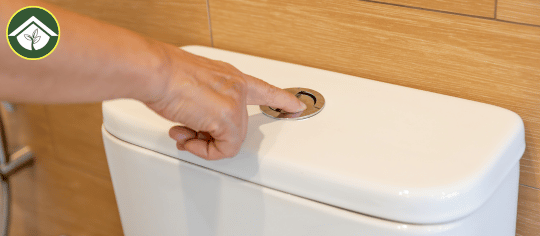
The toilet bowl flush button is one of the most frequently used yet least understood fixtures in any home or commercial bathroom. You press it dozens of times each week without a second thought — until the day it sticks, stops working, or turns your toilet into a noisy, water-wasting machine. Whether you’re dealing with a push button toilet flush that won’t respond, a dual flush button that only works on one side, or an air push button flush that has completely given up, understanding how this small but critical component works is the first step toward fixing it yourself, choosing the right replacement, and avoiding costly plumber calls.
This guide covers everything you need to know about the toilet bowl flush button — from the mechanics behind how push button toilet flush systems work, to the full range of types available today, the internal parts that make them tick, the most trusted brands on the market, how to diagnose and repair common faults, and when a simple replacement is the smarter choice. Whether you own a residential toilet with a top flush button or manage a commercial facility with Sloan push button flush valves and urinal flush valve push buttons, this is the most complete reference you’ll find.
What Is a Toilet Bowl Flush Button and How Does It Work:
A toilet bowl flush button is a mechanical (or pneumatic, or electronic) actuator mounted on top of or in the cistern of a toilet. When pressed, it triggers the internal flush valve to release a controlled volume of water from the tank into the toilet bowl, clearing waste and replenishing fresh water.
Unlike a traditional side-lever flush, which lifts a flapper via a chain, the toilet bowl flush button connects to the flush valve through one of several mechanisms:
- Direct-push rods — the button physically depresses a rod that lifts the flush valve
- Connecting cables — a flexible cable runs from the button down to the valve actuator
- Pneumatic (air) tubes — pressing the button compresses air through a small tube, which expands a bellows inside the cistern to lift the flush valve
According to Wikipedia’s entry on flush toilets, modern gravity-fed cistern toilets are among the most water-efficient domestic appliances when operating correctly, and the flush actuator — whether a button or lever — is central to maintaining that efficiency.
The Basic Mechanism of a Push Button Toilet Flush:
When you press a push button toilet flush, here is what happens in sequence:
- The button travels downward, engaging a rod, cable, or air bladder connected to the flush valve inside the cistern.
- The flush valve lifts, breaking the seal at the bottom of the cistern.
- Water flows by gravity through the flush valve into the toilet bowl.
- In a dual flush system, the volume of water released depends on which button is pressed — small button for a partial flush, large button for a full flush.
- Once the cistern empties to the valve’s cutoff point, the valve drops back and reseals.
- The fill valve opens and refills the cistern to its set water level.
Types of Toilet Bowl Flush Button — The Full Range Explained:
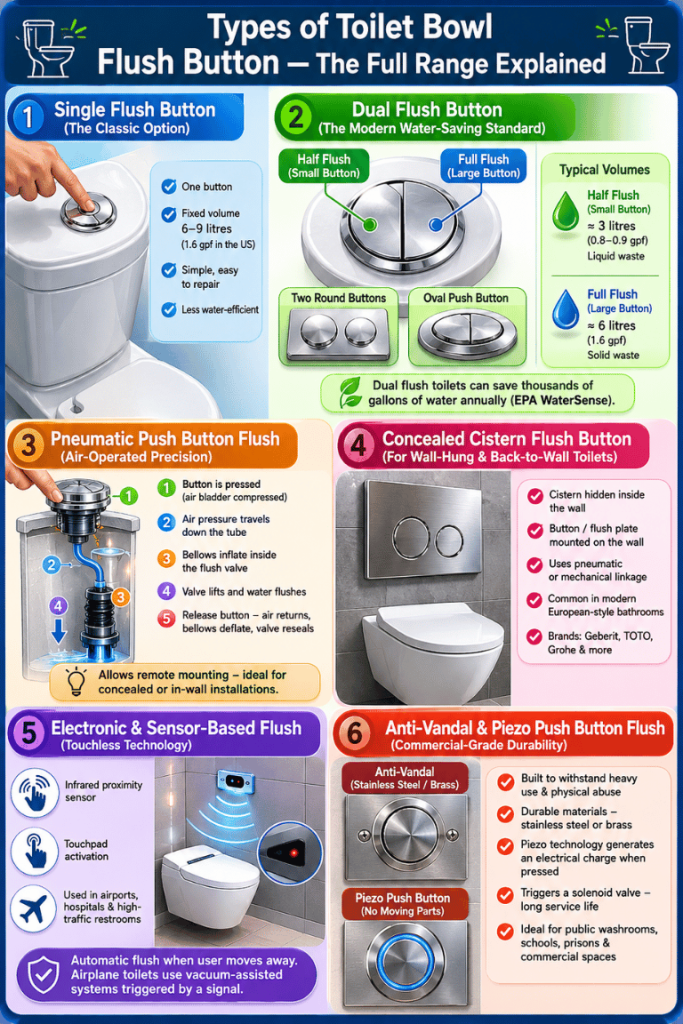
Understanding the types of push button toilet flush systems is essential before purchasing a replacement or diagnosing a problem. Each type has distinct mechanics, advantages, and failure points.
Single Flush Button — The Classic Option:
The single flush button is the simplest design, featuring one button that releases a fixed volume of water — typically between 6 and 9 litres (1.6 gpf in the US) — every time it is pressed. These are commonly found in older cisterns and budget toilets. While straightforward and easy to repair, they are not water-efficient compared to modern alternatives, since every flush uses the same high volume regardless of the type of waste.
Dual Flush Button — The Modern Water-Saving Standard:
The dual flush button has become the global standard for residential and commercial toilets. It features two buttons — a smaller button for a partial (half) flush and a larger button for a full flush.
As explained by the US Environmental Protection Agency’s WaterSense program, dual flush toilets can save a household thousands of gallons of water annually compared to older single-flush models. The two flush volumes typically are:
- Half flush / small button — releases approximately 3 litres (0.8 to 0.9 gpf) for liquid waste
- Full flush / large button — releases approximately 6 litres (1.6 gpf) for solid waste
The most common dual flush button design is circular, with a larger crescent-shaped outer ring and a smaller inner oval. Other configurations include two round buttons side by side, or an oval push button toilet flush with two distinct zones on one oval face.
Pneumatic Push Button Flush — Air-Operated Precision:
The pneumatic (air) push button flush is a more modern and increasingly popular option, especially in concealed cistern and wall-hung toilet installations. Instead of mechanical rods or cables, it uses a small pneumatic tube to transmit air pressure from the button to the flush valve bellows inside the cistern.
When the button is pressed, it squeezes a small air bladder or piston, sending a pulse of compressed air down the tube. This air pressure inflates a bellows inside the cistern valve, which lifts the valve and initiates the flush. When the button is released, the air returns, the bellows deflate, and the valve reseals.
The advantage of pneumatic systems is that they allow the button to be mounted remotely from the cistern — a significant benefit for in-wall or concealed installations. The most common failure in these systems is a split air bladder or a cracked tube, which causes the air push button toilet flush not working issue that many homeowners encounter.
Concealed Cistern Flush Button — For Wall-Hung and Back-to-Wall Toilets:
Concealed cistern flush buttons (also called in-wall flush plates or access panels) are used when the cistern is hidden within the wall cavity. The button or plate is mounted flush on the wall or on a frame around the toilet, and activates the hidden cistern via pneumatic or mechanical linkage. These are frequently seen in contemporary European-style bathrooms.
Brands like Geberit, TOTO, and Grohe specialise in concealed cistern systems with interchangeable flush plate designs ranging from glass to stainless steel.
Electronic and Sensor-Based Flush — Touchless Technology:
Electronic flush systems eliminate the physical button entirely, replacing it with an infrared proximity sensor or a touchpad. These are common in airports, hospitals, and high-traffic public restrooms. The sensor detects when a user moves away from the toilet and triggers the flush automatically. This is the technology used in the airplane toilet flush button — though aircraft systems use vacuum-assisted flushing rather than gravity, requiring only a signal rather than mechanical force.
Anti-Vandal and Piezo Push Button Flush — Commercial-Grade Durability:
In public washrooms, prisons, schools, and other high-traffic environments, standard plastic buttons are vulnerable to damage. Anti-vandal flush buttons are made from hardened stainless steel or brass and are designed to withstand physical abuse. Piezo flush buttons work by generating a small electrical charge when pressed, triggering a solenoid valve — eliminating moving parts almost entirely and offering an extremely long service life.
Two Button Toilet Flush vs. Dual Flush Button — Are They the Same?
Yes, in most contexts these terms are interchangeable. A toilet with two flush buttons uses a dual flush mechanism. However, some models feature two completely separate full-flush buttons (for redundancy in commercial settings) rather than a half/full split — so it is worth confirming the function before assuming both types of push button toilet flush in your toilet operate identically.
Toilet Bowl Flush Button Parts — What’s Inside the Mechanism:
Understanding the parts of a toilet bowl flush button assembly helps you identify which component has failed and what needs replacing.
Button Cap and Face Plate:
The visible outer part of the button assembly. Made from plastic, chrome-plated zinc, or stainless steel. On dual flush designs, the face plate contains two separate actuator zones. Cracking, staining, or loss of spring tension in the cap is a common cosmetic and functional issue.
Actuator Rod or Push Rod:
The rod that transmits the pressing force from the button down to the flush valve. Rods can bend, snap, or become misaligned, particularly if they are made from thin plastic. Bent rods are a leading cause of a push button toilet not flushing or flushing only partially.
Pneumatic Tubing and Air Bladder:
In pneumatic systems, flexible PVC tubing runs from the button to the cistern valve. The air bladder inside the button compresses when pressed. A split bladder or cracked tube results in air push button toilet flush not working — the button feels like it clicks but no flush occurs.
Flush Valve (Siphon or Tower Valve):
The cistern-side component that the button activates. In UK-style siphon cisterns, the valve uses a siphoning action; in the increasingly common tower (canister) valve design used in dual flush systems, a rubber seal lifts to allow water to exit. The seal in these valves is the most common wear point — when it fails, the toilet runs continuously.
Cistern Lid and Button Mounting Frame:
The button mounts through a hole in the cistern lid or into a dedicated bracket. Overtightening the locking nut can crack the lid; incorrect frame sizing leads to wobble and misalignment.
Fill Valve:
Separate from but related to the flush button system, the fill valve refills the cistern after each flush. If the fill valve is malfunctioning, the cistern may not reach the correct water level, making the flush weak regardless of button condition.
Major Brands of Toilet Flush Buttons and Push Button Flush Valves:
Sloan — The Commercial Standard for Push Button Flush Valves:
Sloan Valve Company, founded in Chicago in 1906, is the world’s leading manufacturer of commercial flushometers and push button flush valve systems. The Sloan push button flush valve is found in airports, schools, stadiums, and office buildings worldwide. Their concealed Series 900 flushometers use hydraulic push button actuators and are known for their exceptional durability. Sloan’s FLUSHMATE division manufactures pressure-assisted flush systems used in residential toilets by brands including Gerber, Mansfield, and American Standard.
Caroma — The Pioneer of Dual Flush Technology:
Australian brand Caroma is credited with inventing the dual flush toilet in 1980. Caroma dual flush buttons remain a benchmark for water efficiency, and replacement caroma dual flush buttons are widely available through plumbing suppliers and online. Their systems are known for robust engineering, though the caroma dual flush button removal process can be slightly more involved than universal designs.
Glacier Bay — Affordable Retail Dual Flush:
Glacier Bay is a house brand sold through The Home Depot and is popular in North American residential markets. Glacier Bay dual flush toilet buttons are a common search topic because the button assembly design is proprietary to each toilet model, meaning glacier bay dual flush button replacements must be model-matched carefully.
Fluidmaster — The Go-To Repair and Replacement Brand:
Fluidmaster is the world’s most widely sold toilet repair brand, best known for their fill valves and dual flush conversion kits. Their dual flush button assemblies and universal flush valves are available in most hardware stores globally, making them the first choice for DIY toilet flush button repair and replacement.
Geberit — Concealed Cistern Excellence:
Swiss company Geberit manufactures high-end concealed cistern systems and in-wall flush plates used extensively in European construction. Their pneumatic and mechanical actuator plates are available in a wide range of designer finishes, from matte white to polished chrome and glass.
TOTO — Japanese Precision Engineering:
TOTO is Japan’s largest toilet manufacturer and a global leader in washlet and electronic flush technology. Their push button and sensor flush systems are known for silent operation and exceptional longevity.
Other Notable Brands:
Additional brands making quality toilet bowl flush button systems include Kohler, American Standard, Roca, Duravit, Thomas Dudley (UK), and Siamp.
Toilet Flush Button Repair — Step-by-Step DIY Guide:
Most toilet flush button problems can be resolved without calling a plumber. Here is a systematic approach to repairing common faults.
Tools and Materials You Will Need:
- Adjustable wrench or pliers
- Flathead and Phillips screwdrivers
- Replacement button assembly or flush valve seal (as needed)
- Silicone grease
- Dry cloth and bucket
How to Fix a Running Toilet with a Button Flush:
A running toilet — where water continuously trickles into the bowl — is the most common complaint associated with push button cisterns. The causes and fixes include:
Worn flush valve seal: The rubber seal at the base of the tower valve degrades over time, allowing water to seep past it continuously. Turn off the water supply, flush to empty the cistern, lift out the valve assembly, and replace the seal. Seal kits are inexpensive and available for all major brands.
Stuck or misaligned push button: If the button is depressed slightly and not returning to its full resting position, the actuator may be keeping the flush valve partially open. Remove the button, inspect the spring and rod alignment, and reseat or replace the button assembly.
Float set too high: If the cistern water level exceeds the overflow tube height, water will constantly run into the bowl. Adjust the float arm or float valve to lower the water level by approximately 1 cm below the overflow tube top.
Debris in the valve seat: Limescale, grit, or debris lodged under the valve seal prevents a full seal. Carefully clean the valve seat with a damp cloth and descaling solution.
How to Fix a Toilet Flush Button That Won’t Flush:
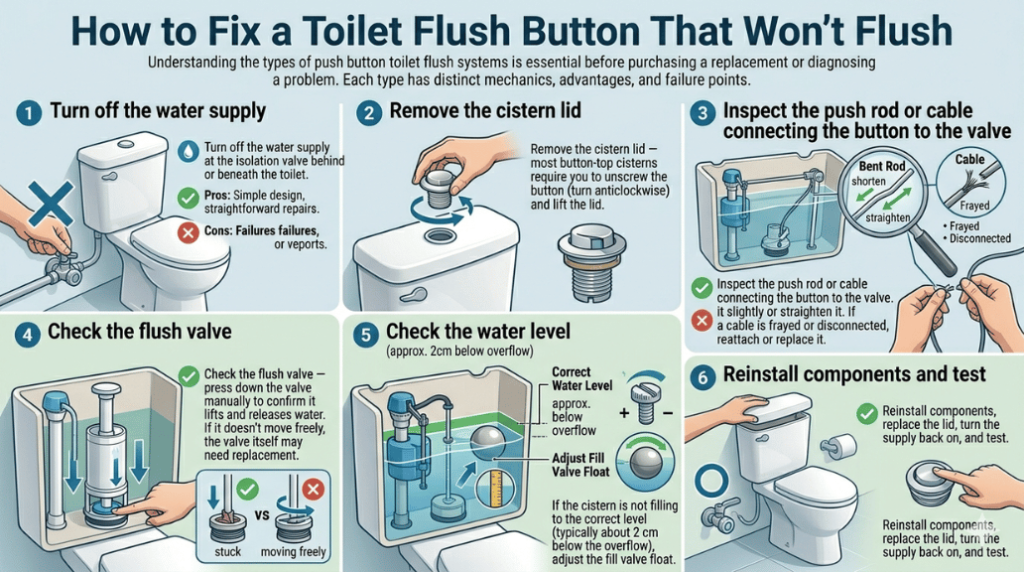
Step 1: Turn off the water supply at the isolation valve behind or beneath the toilet.
Step 2: Remove the cistern lid — most button-top cisterns require you to unscrew the button (turn anticlockwise) and lift the lid.
Step 3: Inspect the push rod or cable connecting the button to the valve. If the rod is bent, shorten it slightly or straighten it. If a cable is frayed or disconnected, reattach or replace it.
Step 4: Check the flush valve — press down the valve manually to confirm it lifts and releases water. If it doesn’t move freely, the valve itself may need replacement.
Step 5: Check the water level. If the cistern is not filling to the correct level (typically about 2 cm below the overflow), adjust the fill valve float.
Step 6: Reinstall components, replace the lid, turn the water supply back on, and test.
How to Fix Toilet Flush with Push Button (Pneumatic Systems):
For air push button toilet flush not working scenarios, the diagnostic process is slightly different:
- Disconnect the pneumatic tube from the cistern valve.
- Press the button while placing your thumb over the open tube end. You should feel a clear puff of air. If you feel nothing or the air escapes from around the button, the air bladder inside the button has split and needs replacement.
- Reconnect the tube and check it for cracks along its length. Even a pinhole leak will reduce pressure enough to prevent a flush.
- Check the bellows on the valve side — if compressed air is confirmed at the button end but the valve doesn’t lift, the cistern bellows may be hardened or split.
- Replace only the faulty component — individual air buttons, tubes, and valve bellows are all sold separately.
How to Fix a Flush Button That Is Sticking:
A flush button sticking in the down position is usually caused by:
- Broken or weak button spring — replace the button assembly
- Swollen or warped button cap — moisture ingress can cause plastic to expand; replace the cap
- Limescale buildup around the button shaft — soak the assembly in white vinegar for 30 minutes and scrub clean
- Overtightened mounting nut — loosen the retaining nut slightly to free the button
Toilet Bowl Flush Button Replacement — When and How:
When to Replace Instead of Repair:
Replacement is the smarter choice when:
- The button cap is cracked or broken
- The push rod has snapped
- The dual flush mechanism only operates one flush volume regardless of which button is pressed
- The entire cistern valve assembly is worn and leaking
- Parts for the specific model are no longer available
How to Replace a Dual Flush Button — Step by Step:
- Turn off the water supply and flush the cistern empty.
- Locate the button retaining nut underneath the cistern lid. On most designs, the button cap unscrews anticlockwise while the lid is held steady.
- Lift the lid clear of the cistern and place it safely aside.
- Disconnect the push rods or pneumatic tubes from the old button assembly.
- Select a compatible replacement — check the manufacturer, the button hole diameter (typically 38mm or 50mm), and the button type (mechanical rod, cable, or pneumatic).
- Install the new button assembly by reversing the removal steps. Ensure push rods are adjusted to the correct length so both buttons engage the valve cleanly.
- Hand-tighten the retaining nut — do not overtighten, as this can crack the cistern lid.
- Restore water supply, allow the cistern to fill, and test both flush buttons.
Universal vs. Model-Specific Dual Flush Button Replacements:
Universal dual flush button kits (such as those from Fluidmaster) fit a wide range of cisterns but may require rod length adjustment. Model-specific replacements (such as Caroma dual flush buttons or Glacier Bay dual flush button assemblies) are exact-fit parts for their respective toilet models. When in doubt, photograph the existing button and valve assembly before purchasing a replacement, and check the manufacturer’s part number.
Push Button Flush Valve for Urinals — Commercial Applications:
The push button urinal flush valve is a distinct product category from domestic toilet flush buttons. Urinal flush valves (flushometers) are direct water-supply valves that do not use a cistern — water flows directly from the supply pipe through the valve and into the urinal on each flush.
The urinal flush valve push button activates a diaphragm or piston inside the flushometer that briefly opens the water path. Sloan, Zurn, and American Standard are the leading manufacturers of these valves. Common problems with urinal push button flush valves include:
- Weak or no flush — worn diaphragm or clogged strainer
- Continuous running — damaged diaphragm seat or relief valve
- Button not returning — worn button spring or damaged actuator
Maintenance of commercial push button urinal flush valves is covered by standards from the American Society of Plumbing Engineers (ASPE) and typically should be performed by a qualified plumber.
Dual Flush Toilet Button Adjustment — Getting the Volume Right:
If your dual flush toilet is wasting water (full flush too large) or not clearing waste effectively (full flush too weak), the flush volume can often be adjusted without replacing any parts.
Most dual flush valve assemblies have an adjustable float or collar that sets the water level in the cistern, which in turn determines the flush volume. Raising the water level increases flush volume; lowering it reduces the volume. Consult your toilet’s installation manual for the specific adjustment method, as it varies by brand and valve design.
For dual flush toilet button adjustment beyond water level — such as adjusting which button triggers which flush volume — you will typically need to access the actuator rod lengths inside the button assembly and lengthen or shorten them until each button correctly engages its respective valve chamber.
Common Push Button Toilet Flush Problems and Solutions:
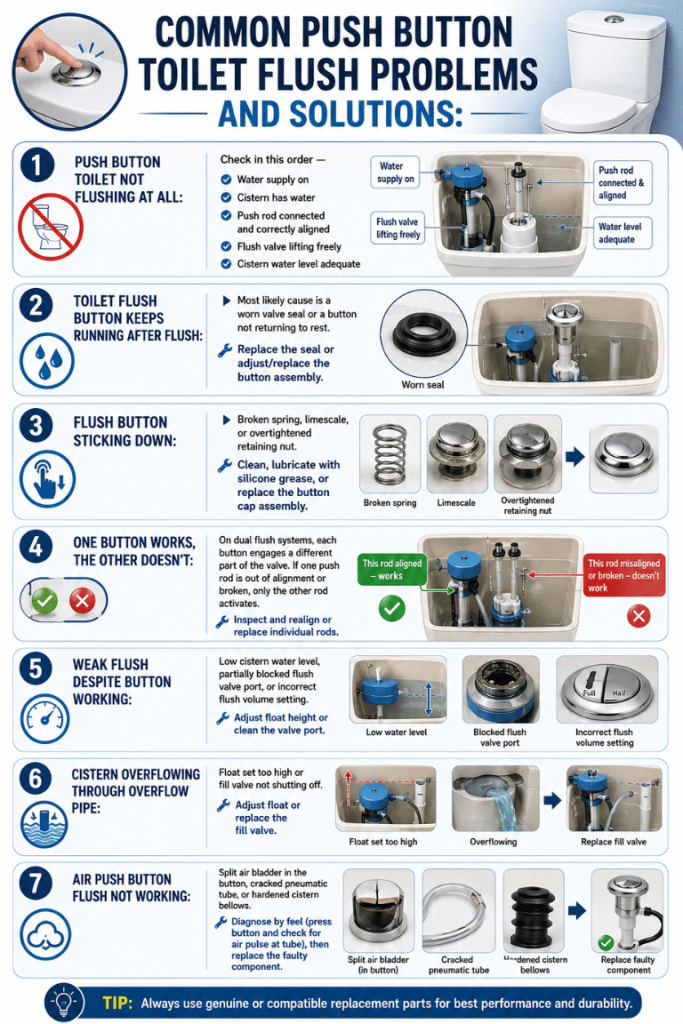
Push Button Toilet Not Flushing at All:
Check in this order — water supply on, cistern has water, push rod connected and correctly aligned, flush valve lifting freely, cistern water level adequate.
Toilet Flush Button Keeps Running After Flush:
Most likely cause is a worn valve seal or a button not returning to rest. Replace the seal or adjust/replace the button assembly.
Flush Button Sticking Down:
Broken spring, limescale, or overtightened retaining nut. Clean, lubricate with silicone grease, or replace the button cap assembly.
One Button Works, the Other Doesn’t:
On dual flush systems, each button engages a different part of the valve. If one push rod is out of alignment or broken, only the other rod activates. Inspect and realign or replace individual rods.
Weak Flush Despite Button Working:
Low cistern water level, partially blocked flush valve port, or incorrect flush volume setting. Adjust float height or clean the valve port.
Cistern Overflowing Through Overflow Pipe:
Float set too high or fill valve not shutting off. Adjust float or replace the fill valve.
Air Push Button Flush Not Working:
Split air bladder in the button, cracked pneumatic tube, or hardened cistern bellows. Diagnose by feel (press button and check for air pulse at tube), then replace the faulty component.
How to Flush an Automatic Toilet with No Button:
If you encounter a sensor-activated or automatic toilet — common in airports, hotels, and modern offices — and the sensor is not responding, most automatic flush valves include a manual override button. Look for a small button or tab on the flush valve body itself (usually on the side or face of the chrome or stainless valve), separate from the sensor eye. Pressing this manual override button will activate the flush directly.
On some modern automatic urinals and toilets, the manual override is intentionally recessed to prevent tampering. In that case, waving your hand slowly in front of the sensor at close range (within 5 cm) can sometimes trigger the flush manually.
Frequently Asked Questions About the Toilet Bowl Flush Button
What is a toilet bowl flush button and how does it differ from a lever flush?
A toilet bowl flush button is a push-type actuator mounted on the cistern lid or wall plate that triggers the flush valve via a rod, cable, or air tube. A lever flush uses a side-mounted handle connected by a chain to a rubber flapper. Push button toilets typically offer dual flush technology and a sleeker appearance, while lever flush systems are simpler to repair using widely available parts.
How does a push button toilet flush work inside the cistern?
Pressing the button moves a rod or pushes air through a tube to lift the flush valve inside the cistern. Once the valve lifts, gravity pulls water from the cistern into the toilet bowl. In a dual flush system, the small button lifts a partial valve release mechanism, while the large button fully opens the valve for a larger water volume.
What are the two types of push button toilet flush?
The two main types are single flush (one button, fixed water volume) and dual flush (two buttons — partial flush and full flush). A further distinction can be made between mechanical push button systems (using rods or cables) and pneumatic push button systems (using air pressure tubes).
Which button do you push on a dual flush toilet for liquid waste?
For liquid waste, press the smaller button — this delivers a partial flush of approximately 3 litres (0.8 to 0.9 gallons). The larger button is for solid waste and delivers the full flush volume of approximately 6 litres (1.6 gallons).
Why is my push button toilet not flushing when I press the button?
The most common reasons are: a disconnected or bent push rod, a cistern water level that is too low, a jammed or broken flush valve, or a split air bladder in a pneumatic button system. Removing the cistern lid and visually inspecting the rod and valve connection usually identifies the cause quickly.
How do I fix a toilet flush button that is stuck down?
Gently wiggle the button upward while pressing down slightly to free it from any jam. If it stays stuck, remove the cistern lid, disconnect the retaining nut, and lift out the button assembly. Inspect the spring and button shaft for limescale buildup or a broken spring, clean or replace as needed, and reinstall.
What causes a running toilet with a push button flush?
Running water after a flush on a button-flush toilet is almost always caused by a worn flush valve seal, a button not returning fully to its resting position, a cistern water level set above the overflow tube, or debris under the valve seat preventing a full seal.
How do I fix a running toilet with a button flush without a plumber?
Turn off the water supply, empty the cistern by flushing, remove the flush valve, and replace the rubber seal at the valve base. Seal replacement kits are available at most hardware stores for under $10 and take about 15 minutes to fit. If the seal is intact, check the float height and button spring.
What is a dual flush button and how does the replacement work?
A dual flush button is a two-zone actuator that triggers either a partial or full flush. To replace it, unscrew the button cap anticlockwise from the cistern lid, lift the lid, disconnect the old button assembly’s rods or tubes, fit the replacement (matching the hole diameter and valve type), adjust rod lengths as needed, and reinstall the lid.
What is the difference between an oval push button toilet flush and a round one?
The oval push button toilet flush is an aesthetic design variation — the button face is oval-shaped rather than circular, which suits certain toilet styles and cistern lid designs. Functionally, both types operate identically through the same rod or pneumatic mechanism. The oval design is more common in European-manufactured toilets.
Why is my air push button toilet flush not working?
The most likely cause is a split or hardened air bladder inside the button, or a cracked pneumatic tube. Test by disconnecting the tube from the cistern valve and pressing the button — you should feel a firm puff of air at the tube end. If you feel no air or air escaping around the button, the button’s internal bladder needs replacement.
What is a Sloan push button flush valve and where is it used?
The Sloan push button flush valve is a commercial flushometer — a direct-supply flush valve that bypasses cistern technology entirely. It is used in tankless commercial and institutional toilets and urinals. Pressing the actuator briefly opens a measured water flow directly from the supply pipe into the fixture. Sloan has manufactured these valves since 1906 and they are the standard in North American commercial plumbing.
How do I remove a dual flush button from the cistern lid?
On most designs, grip the cistern lid firmly and unscrew the button cap anticlockwise (counterclockwise). It will unthread from its mounting tube. On some models, a flathead screwdriver is needed to release a locking tab before the button can turn. Once the cap is removed, the lid lifts free of the cistern.
What is a top button flush toilet and how is it different from a side lever toilet?
A top button flush toilet has the flush actuator built into the top of the cistern lid — the button or buttons face upward and are pressed downward to flush. This design allows the cistern to sit neatly against the wall without requiring side clearance for a lever, resulting in a cleaner, more compact appearance. It is the dominant design in modern European and Australian bathrooms.
How do I fix a dual flush button that only flushes one volume?
If pressing either button produces the same flush volume, one of the two actuator rods is likely disconnected, too short, or broken. Remove the cistern lid, check that both rods reach their respective valve positions, and adjust their length (most rods are adjustable or clip-together) so each button cleanly engages only its designated valve chamber.
What is a push button flush tank and how is it different from a standard cistern?
A push button flush tank is simply a toilet cistern (water tank) equipped with a push button actuator on its lid rather than a side-mounted lever. The internal components — fill valve, flush valve, overflow tube — are the same in principle. The main difference is that the flush valve in a push button tank is designed for vertical actuation rather than chain-lift actuation.
Can I replace a handle-flush toilet with a push button toilet flush valve?
Yes, in most cases. Dual flush conversion kits are available that replace the internal cistern components (flush valve and button assembly) of a lever-flush toilet, converting it to a dual push button toilet flush system. Fluidmaster’s dual flush converter kits are among the most widely used for this purpose. The cistern lid will also need to be drilled for the button opening if it doesn’t already have one.
What is the WC dual flush button and why does it sometimes have a square or rectangular shape?
WC (water closet) dual flush buttons come in a wide range of shapes — circular, oval, square, and rectangular — to suit different cistern designs and aesthetic preferences. Square and rectangular buttons are common on concealed cistern systems where the button is part of a larger flush plate mounted on the wall. The shape does not affect function; it is purely aesthetic.
What does the Glacier Bay dual flush button look like and how do I replace it?
Glacier Bay dual flush toilet buttons are typically round, white or chrome-finished, and sit on the top of the cistern lid. Replacement buttons must be matched to the specific Glacier Bay toilet model, as the rod lengths and valve connections vary. The Home Depot stocks model-specific Glacier Bay replacement parts, and the manufacturer’s website provides model number guidance for correct part identification.
How do I flush an automatic toilet with no button when the sensor doesn’t work?
Look for a small manual override button on the body of the flush valve sensor unit — it is often a small chrome or matte button on the valve housing itself, below the sensor eye. Press and hold it for one to two seconds. If no override button is present, wave your hand slowly in front of the sensor lens at close range. If neither works, report the non-functioning unit to facility management.
What is the airplane toilet flush button and how does it work?
The airplane toilet flush button triggers a vacuum-assisted waste removal system rather than a gravity water flush. When pressed, the button opens a valve that creates a powerful pressure differential between the waste chamber and a lower-pressure holding tank, sucking waste and a small amount of flush water into the holding tank. This vacuum system uses far less water than a conventional gravity flush and is unaffected by altitude or aircraft orientation.
How do I know if I need to repair or replace my toilet bowl flush button?
Repair is usually appropriate for: stuck buttons (clean or replace spring), weak flush (adjust water level or clean valve), or running toilet (replace seal). Replacement is the better choice when: the button body is physically broken, the push rods have snapped, the valve assembly is worn out, or the toilet is older and all internal seals are failing together. As a rule of thumb, if the repair cost exceeds roughly one-third of the toilet’s replacement value, upgrading the entire cistern mechanism makes more economic sense.
What maintenance should I do to keep my push button toilet flush working correctly?
Descale the button and surrounding area every six months using white vinegar to prevent limescale buildup, particularly if you have hard water. Annually, remove the cistern lid and inspect the flush valve seal for wear. Lubricate the button shaft and spring with a small amount of silicone grease every 12 to 18 months to prevent sticking. Avoid overtightening the button retaining nut, as this is a leading cause of cracked cistern lids.
Are push button toilet flush systems more water-efficient than lever flush toilets?
Yes, significantly. Because push button toilet flush systems almost universally incorporate dual flush technology, they allow users to select a reduced flush volume for liquid waste. The US EPA’s WaterSense program estimates that replacing older 3.5 gpf toilets with modern dual flush 1.28 gpf models can save a family of four more than 16,000 gallons of water per year. Lever flush toilets can incorporate dual flush technology, but the majority of lever-flush toilets sold today are single-flush designs.


Leave a Reply