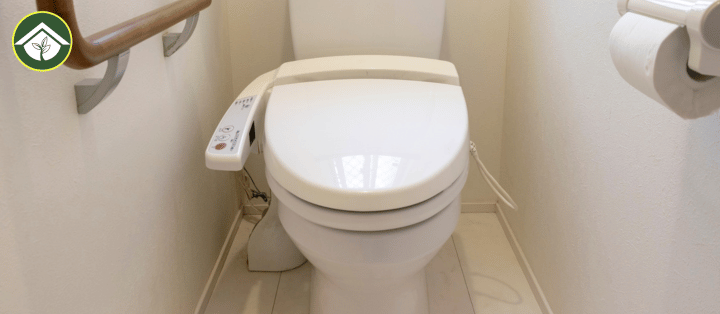
The bathroom is one of the most hazardous rooms in any home for older adults — and the toilet is at the center of that risk. According to the Centers for Disease Control and Prevention (CDC), over 230,000 Americans suffer bathroom injuries annually, with falls representing the leading cause of fatal and nonfatal injuries among older adults. The act of lowering onto a standard-height toilet and pushing back up to standing places enormous demand on the hips, knees, and lower back — precisely the joints most affected by aging, arthritis, and post-surgical recovery. A raised toilet seat for seniors is one of the most practical, affordable, and immediately impactful home modifications available. This guide covers every type, feature, and consideration — from raised toilet seats with arms to adjustable toilet seat height for seniors, toilet seat lifts for mobility issues, and everything in between.
Why Standard Toilet Height Creates a Problem for Aging Adults:
Most residential toilets sit between 14.5 and 15 inches from the floor to the top of the bowl rim — a height that requires significant hip and knee flexion to use safely. For a younger adult with full muscle strength and joint flexibility, this presents no challenge. For a senior managing muscle loss (clinically known as sarcopenia), hip or knee arthritis, osteoporosis, or recovering from joint replacement surgery, that downward movement can be painful, destabilizing, and genuinely dangerous.
The Americans with Disabilities Act (ADA) defines an accessible toilet seat height as 17 to 19 inches from the finished floor — two to four inches higher than the residential standard. That seemingly small gap is often the difference between using the toilet independently and requiring caregiver assistance. A toilet seat riser for elderly users bridges exactly that gap without requiring expensive plumbing renovations or full bathroom remodels.
Raised Toilet Seat for Seniors — Types and How They Differ:
Understanding the range of products on the market is essential before making a purchase. The three most common raised toilet seat types used in place of standard seats are basic raised seats, raised toilet seats with a locking mechanism that attaches to the toilet bowl, and raised toilet seats with arms that provide users with leverage while lowering to sit or rising to stand.
Basic Clip-On or Bubble-Type Raised Seats:
These are the most widely available and affordable option. They rest directly on top of the existing toilet bowl without requiring tools or hardware. They offer a quick and easy solution because they don’t come with locks or hand grips — to install them, you simply place them over the bowl opening and press down. They suit users who have reasonable balance and simply need a few extra inches of height to reduce joint strain.
Locking Raised Toilet Seats:
These include adjustment bolts or tightening knobs that secure the seat to the bowl, eliminating any wobble or shifting during use. Locking mechanisms allow you to ensure the toilet seat fits securely into the bowl — however, they can be more complicated to install, as most require either adjusting bolts to the seat or tightening an adjustment knob. These are the preferred option for users with balance concerns or heavier body weight.
Raised Toilet Seats with Arms:
An elevated toilet seat for seniors with integrated armrests allows the user to press down on the arms while lowering and push up from them when standing. For people with balance and lower body strength issues, the addition of support arms gives users hand grips to steady themselves and use for leverage while raising and lowering onto the toilet seat. These are particularly recommended for anyone recovering from hip or knee replacement surgery, or managing Parkinson’s disease, stroke, or multiple sclerosis.
Adjustable-Height Raised Toilet Seats:
An adjustable toilet seat height for seniors addresses the reality that users’ needs change over time. While usually more expensive, adjustable raised toilet seats allow you to control the height through clamps that go on the side of the toilet, which can be set higher or lower depending on preference. These are ideal for households where multiple family members use the same bathroom, or where a senior’s mobility is likely to change further.
Toilet Safety Frames and Freestanding Commodes:
Safety frames are freestanding structures placed over the toilet that include a separate elevated seat. They provide maximum stability and are excellent for heavier users, with many models allowing for adjustments in height and width. These structures do require more floor space, but they eliminate installation complexity entirely since nothing attaches to the toilet itself.
Toilet Seat Lift Mechanisms:
For seniors who lack the leg and core strength even to push up from armrests, a toilet seat lift for mobility issues provides powered assistance. These mechanical or electric devices slowly raise the seated user toward standing position, reducing fall risk to near zero during the transition. A toilet seat lift mechanism is a device with a seat that can be raised with or without a forward tilt while the patient is seated, allowing the patient to stand and ambulate once in an upright position. It may be manually operated or electric.
Key Features to Evaluate When Choosing a Handicap Bathroom Toilet Riser:
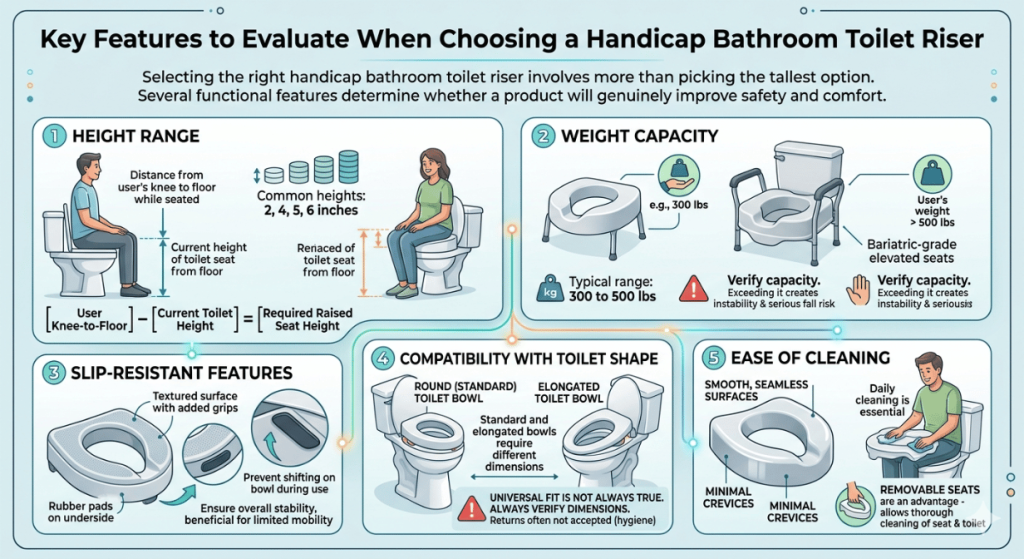
Selecting the right handicap bathroom toilet riser involves more than picking the tallest option. Several functional features determine whether a product will genuinely improve safety and comfort.
Height Range:
Elevated toilet seats come in heights of 2, 4, 5, and 6 inches. The right height depends on the user’s body — specifically the distance from their knee to the floor while seated. To find the correct fit: measure the distance from the user’s knee to the floor, then measure the current height of the toilet seat from the floor upwards. Subtract the toilet height from the knee measurement — the difference is the height of the raised toilet seat required.
Weight Capacity:
Weight capacity varies significantly between products. Weight capacities typically range from 300 to 500 lbs for heavy-duty models. Bariatric-grade elevated seats accommodate users well beyond that range. Always verify weight capacity before purchase, as exceeding it creates instability and serious fall risk.
Slip-Resistant Features:
Many raised toilet seats have a textured surface with added grips that ensure overall stability even when the user changes position. Those with limited mobility and strength benefit significantly from this feature. Rubber pads on the underside of the seat also prevent the unit from shifting on the bowl during use.
Compatibility with Toilet Shape:
Standard (round) and elongated toilet bowls require different raised seat dimensions. Most people find an elongated toilet bowl shape most comfortable for various reasons. Many products are marketed as universal fit, but always verify before purchasing — returns are often not accepted on toilet-related products for hygiene reasons.
Ease of Cleaning:
Daily cleaning is essential for hygiene. Raised seats with smooth, seamless surfaces and minimal crevices are far easier to wipe down than those with complex contours. Removable seats are an advantage here, allowing thorough cleaning of both the raised seat and the toilet beneath.
How to Install a Raised Toilet Seat Safely:
Most toilet seat risers for elderly users are designed for tool-free installation. The basic process involves removing the existing toilet seat, placing the raised seat over the bowl rim, and tightening the securing brackets or bolts until the seat is completely stable with no lateral movement. Before any use, confirm the seat doesn’t rock or slide by applying downward and side pressure with your hands.
For locking models, bracket arms typically extend down the outside of the bowl and tighten inward. For bolt-on models, the raised seat replaces the original seat entirely using the same bolt holes at the back of the bowl. A bolted raised toilet seat is the best option if using a seat with a lid is a necessity, as non-bolting raised seats prevent the lid from going up or down.
If in doubt, an occupational therapist (OT) can advise on the correct product and demonstrate installation as part of a home safety assessment — a service often available through local aging-in-place programs and community health services.
Does Medicare Cover a Raised Toilet Seat for Seniors:
This is one of the most common questions caregivers and seniors ask — and the answer requires nuance. Original Medicare (Parts A and B) typically does not cover bathroom safety devices like grab bars, shower chairs, and raised toilet seats, as they are considered convenience items rather than medically necessary equipment.
The Centers for Medicare & Medicaid Services (CMS) formally classifies raised toilet seats under HCPCS code E0244 as non-covered items. However, there are two important exceptions. First, Medicare Advantage plans may offer some coverage if your plan includes supplemental OTC (over-the-counter) benefits. Second, a bedside commode chair used for medical necessity — when a patient cannot reach the toilet — may qualify under Medicare Part B as durable medical equipment. Veterans may access funding through the VA’s Home Improvements and Structural Alterations (HISA) grant program, which covers bathroom accessibility modifications. Some state Medicaid waiver programs and nonprofit organizations such as Rebuilding Together also provide assistance for eligible low-income seniors.
Pairing a Raised Toilet Seat with Other Bathroom Safety Modifications:
A raised toilet seat works best as part of a broader bathroom safety strategy. Combining raised seats with accessories like grab bars and non-slip mats enhances overall bathroom safety. Wall-mounted grab bars positioned beside the toilet allow seniors to brace during the sit-to-stand transition, which is when the highest fall risk occurs. Non-slip flooring or bath mats prevent foot slippage on wet surfaces, and adequate lighting — particularly at night — ensures the path to and from the bathroom is clearly visible.
For seniors transitioning from the hospital after hip or knee surgery, occupational therapists typically conduct a home assessment and recommend the full combination of aids appropriate to the individual’s specific mobility profile and recovery stage.
FAQ: Raised Toilet Seat for Seniors
What is a raised toilet seat and who needs one?
A raised toilet seat — also called an elevated toilet seat, toilet riser, or toilet booster seat — is an assistive device that attaches to or sits on top of an existing toilet to increase its seat height by 2 to 6 inches. It is used by elderly individuals, those with mobility issues, or those recovering from surgery who may benefit from a higher seat that reduces strain on joints and makes sitting and standing easier. While most commonly associated with seniors, they also benefit anyone with arthritis, hip or knee problems, Parkinson’s disease, or temporary post-surgical mobility limitations.
How high should a raised toilet seat be for an elderly person?
There is no single universal answer — the correct height depends on individual body measurements. The recommended approach is to sit on a firm chair with knees and hips at the same height, then measure from the floor to the back of the thigh just behind the knee. That measurement is your target seat height. Subtract the current toilet height from that figure to find the required riser height. Ideally, once seated, the user’s feet should rest flat on the floor with hips and knees at approximately a 90-degree angle.
What is the difference between a raised toilet seat and a toilet seat riser?
The two terms are often used interchangeably, but there is a functional distinction. A raised toilet seat replaces the original toilet seat entirely — the original seat is removed and the raised seat takes its place. A toilet seat riser, by contrast, is sandwiched between the toilet bowl and the original seat, so the user is still sitting on the original seat but at a greater height. The choice between them depends on installation preference, budget, and whether the original seat needs to remain accessible for other users.
Are raised toilet seats with arms better than those without?
For users with significant balance challenges, weak leg muscles, or recovering from lower-body surgery, armrests provide a meaningful safety advantage. They allow the upper body to assist during the sit-to-stand transition, reducing the load on the hips and knees. That said, hand grips aren’t designed to fully support the user’s complete body weight and should be used with care. For users who are stable on their feet and only need modest height assistance, a locking seat without arms may be sufficient and easier to clean.
Will a raised toilet seat fit my toilet?
Most products are designed to fit standard round or elongated toilet bowls, but compatibility varies. Standard toilet bowls are smaller by a few inches than elongated bowls. Not all models are universal, so be sure to check whether the seat you are buying is a universal fit or specifically for either a standard or elongated bowl. Measure from the front edge of the bowl rim to the center point between the two seat bolt holes — if the distance is approximately 16.5 inches, you have an elongated bowl; if it is closer to 14 inches, you have a round bowl.
Can I use a raised toilet seat if I use a wheelchair?
Yes, but the height calculation is different. For a wheelchair user, the goal is to facilitate a safe, level lateral transfer from the wheelchair seat to the toilet. A successful lateral transfer depends on the toilet seat being at the exact same height as — or very slightly lower than — the wheelchair seat cushion. If the toilet is too high or too low, the user must dangerously lift or drop their body weight, dramatically increasing fall risk. Measure the wheelchair cushion height from the floor and match the toilet seat to that measurement.
How do I stop a raised toilet seat from slipping?
Slippage is a real concern for users who already face balance challenges. The most reliable solution is to choose a locking model that secures to the bowl via adjustable brackets or bolts. Slip-resistant rubber pads on the raised seat can keep it from moving when in use, and a wider, contoured seat cradles the user better and provides a more stable surface while preventing lateral movement. Always check stability before each use by applying hand pressure from multiple directions.
Does Medicare pay for a raised toilet seat for seniors?
In most cases, no. Medicare formally classifies a raised toilet seat (HCPCS code E0244) as a non-covered item. However, Medicare Advantage plans may offer some coverage if the plan includes supplemental OTC benefits, though coverage varies significantly by plan and region. Veterans may be eligible for funding through the VA’s HISA grant. Some Medicaid waiver programs in certain states may also contribute — contact your state Medicaid agency for program-specific eligibility.
What is the weight limit for a raised toilet seat?
Weight limits vary widely between products. Standard raised toilet seats typically support between 300 and 500 lbs for heavy-duty models. Bariatric options exist for users with greater weight needs, with some industrial-grade commodes rated to accommodate users well beyond standard limits. Always check the manufacturer’s stated capacity and select a product that provides a comfortable safety margin above the user’s actual weight.
Are adjustable raised toilet seats worth the extra cost?
Yes, in most situations. An adjustable toilet seat height for seniors offers several practical advantages: it can be fine-tuned to match the user’s exact height requirement, it adapts as mobility changes over time, and in multi-user households it can be reconfigured for different family members. Adjustable height settings help reduce the overall strain on the knees and hips and support healthier posture alignment, which contributes to comfort and long-term joint health. The additional cost is modest compared to the safety and flexibility benefit.
Can a raised toilet seat cause constipation?
This is an important but underappreciated consideration. Squatting is the biomechanically optimal position for bowel movements, as it relaxes the pelvic floor muscles. Having the knees bent at less than a 90-degree angle — as with a very high toilet seat — closes off the pelvic floor and can make bowel movements more difficult. The ideal seated position keeps hips and knees at approximately 90 degrees. Selecting a seat height that achieves this angle, rather than going as high as possible, avoids inadvertently creating digestive issues.
How do I clean a raised toilet seat properly?
Daily cleaning is recommended, using the same disinfectant cleaners suitable for standard toilet seats. Choose a model with smooth, seamless surfaces and minimal crevices to simplify the process. Removable raised seats can be taken off the toilet for more thorough cleaning underneath. Most raised toilet seats are made from durable polypropylene or ABS plastic that resists staining and odors and is compatible with standard household disinfectants and antibacterial wipes.
Is a toilet seat riser safe after hip replacement surgery?
Yes — and it is typically recommended. After hip replacement, surgeons generally advise patients to avoid bending the hip beyond 90 degrees during the recovery period, a restriction standard toilet heights often violate. Raised toilet seats reduce strain on surgical sites by minimizing the distance the individual needs to lower themselves, and the addition of armrests can further assist with transfers if shoulder or hand mobility is also a factor. Always confirm the recommended seat height with your surgical team or occupational therapist before installation.
What is a toilet seat lift for mobility issues and how does it work?
A toilet seat lift for mobility issues is a powered or spring-assisted device that physically raises the user from seated to near-standing position, removing the need for leg and core muscle effort during the most dangerous phase of toilet use. A toilet seat lift mechanism uses a seat that can be raised with or without a forward tilt while the patient is seated, allowing the patient to stand and ambulate once in an upright position. It may be manually operated or electric. These devices are appropriate for users with severe lower-body weakness, advanced arthritis, or those who have experienced repeated near-falls during toilet transfers.
Can a raised toilet seat be used as a commode chair?
Some raised toilet seat models double as commode chairs when combined with a freestanding safety frame and waste bucket — commonly called a 3-in-1 commode. A 3-in-1 commode can be used bedside, as a raised toilet seat placed over a regular toilet, or as safety rails around a regular toilet, with push-button height adjustment for simple custom configuration. This versatility makes 3-in-1 commodes a popular choice for caregivers supporting seniors with complex mobility challenges who need both bathroom and bedside solutions.


Leave a Reply