Few health anxieties are as widespread — and as consistently misunderstood — as the fear of catching a sexually transmitted infection from a public toilet seat. Among these concerns, questions about HPV rank near the top. It is an entirely understandable worry: HPV is the most common sexually transmitted infection in the United States, affecting tens of millions of people at any given time, and the bathroom is an intimate space where hygiene questions feel particularly pressing. But is the fear actually grounded in biology? The evidence is clear and consistent across decades of medical research. Understanding what HPV is, how it is actually transmitted, and what the science says about surface survival will not only put this specific worry to rest — it will give you a much more accurate picture of where genuine HPV risk really comes from.
Can You Get HPV from a Toilet Seat — What the Medical Evidence Actually Says:
The straightforward answer, according to public health authorities and decades of epidemiological research, is that contracting HPV from a toilet seat is not a documented route of transmission. The Hawaii State Department of Health states explicitly that there have been no documented cases of HPV transmission through environmental surfaces such as toilet seats. The American Cancer Society similarly confirms that HPV is not spread through blood, body fluids, or contact with surfaces like toilet seats.
This is not simply a reassuring oversimplification — it reflects the biological reality of how HPV behaves outside the human body. HPV requires intimate skin-to-skin contact with infected tissue to establish infection. The virus needs access to the basal cells of the epidermis — the deepest layer of skin — which requires both direct contact with infected skin and some degree of microabrasion or entry point into the tissue. Briefly sitting on a toilet seat does not fulfill these transmission conditions, even in theory.
How HPV Is Actually Transmitted — The Biology Behind the Risk:
The Skin-to-Skin Contact Requirement:
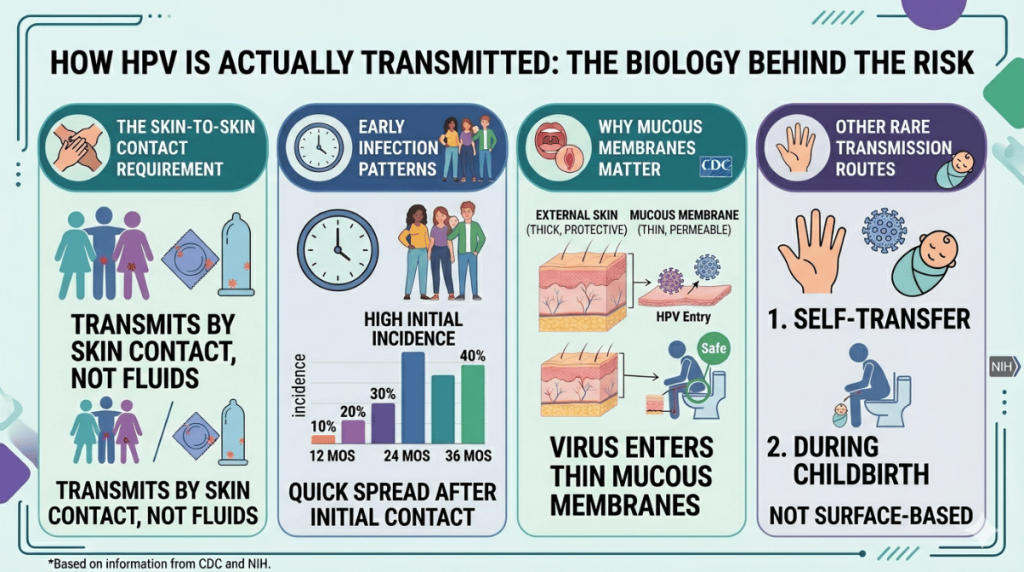
According to the Centers for Disease Control and Prevention (CDC), HPV spreads through intimate skin-to-skin contact. Transmission occurs most commonly during vaginal, anal, or oral sex. Crucially, HPV is not transmitted through bodily fluids such as semen or blood — it is transmitted through direct contact with infected skin or mucous membranes. This means that even correct and consistent condom use does not eliminate HPV risk entirely, because the virus can be present on skin not covered by a condom.
The CDC’s Pink Book chapter on HPV notes that infection typically occurs soon after a person becomes sexually active, with studies of college-aged women showing a cumulative HPV infection incidence of 40% within 24 months of first sexual intercourse. These epidemiological patterns are entirely consistent with sexual transmission and are not consistent with environmental or surface-based transmission.
Why Mucous Membranes Matter:
HPV can enter the body through mucous membranes — tissue found in the genitals, anus, mouth, and throat. These membranes are far more permeable to viral entry than intact, dry, external skin like the thighs or buttocks. Sitting on a toilet seat involves the thighs, buttocks, and perineal skin — not the mucous membranes that HPV requires to establish infection. This anatomical reality is a key reason why toilet seat transmission is considered biologically implausible even when the theoretical presence of viral particles on a surface is considered.
Autoinoculation and Vertical Transmission:
Beyond sexual contact, the National Institutes of Health identifies two additional — and rare — routes of HPV transmission: autoinoculation (self-transfer of the virus from one body site to another on the same person, for example from a hand wart to another skin site) and vertical transmission from an infected mother to her newborn during childbirth. Both are distinctly different from surface-based environmental transmission.
Does HPV Survive on Toilet Seats and Bathroom Surfaces:
What Research Shows About HPV and Surfaces:
This is where the science becomes slightly more nuanced. A peer-reviewed study published in the journal Expert Review of Anti-infective Therapy and available through Taylor & Francis Online reviewed evidence suggesting that HPV can survive outside its human host on some surfaces and objects. The virus has been detected on surgical equipment, examination gloves, and medical instruments. This body of research has prompted calls for better disinfection protocols in clinical settings.
However, detecting the presence of viral DNA on a surface is different from demonstrating that the virus is viable enough to cause infection through incidental contact. The conditions required for HPV transmission — sustained direct contact with susceptible mucosal tissue or broken skin — are simply not replicated by sitting briefly on a dry, hard toilet seat. The virus requires a warm, moist environment close to human tissue temperature (30 to 40 degrees Celsius) to remain active. A porcelain or plastic toilet seat at ambient bathroom temperature does not provide these conditions for long.
How Long Does HPV Survive Outside the Body:
HPV’s survival time outside the human body is limited and highly dependent on environmental conditions. On hard, non-porous surfaces at room temperature, the virus degrades relatively quickly. Exposure to common disinfectants — including soap, alcohol-based cleaners, and standard bathroom surface cleaners — kills HPV effectively. On porous materials like cloth or paper, the virus survives for a shorter period still, often only a matter of hours. This is consistent with why there are no documented cases of HPV infection through toilet seat contact despite the enormous number of people who use public restrooms daily.
Can Women Get HPV from a Toilet Seat:
The answer for women is the same as for everyone: there are no documented cases. The concern tends to be higher among women because HPV is strongly associated with cervical cancer — one of the most serious health consequences of HPV infection. But the anatomical route through which HPV causes cervical infection is through the cervical transformation zone, accessed via vaginal intercourse or direct genital contact — not through perineal or thigh contact with a toilet seat surface. The American Cancer Society’s guidance on HPV prevention makes no mention of toilet seats as a risk factor because the evidence does not support it.
Can Men Get HPV from a Toilet Seat:
Men face the same negligible risk from toilet seats as women. HPV in men most commonly affects the penis, scrotum, anus, and the mouth and throat — areas involved in direct sexual contact, not areas that contact a toilet seat during normal use. HPV-related health consequences in men include genital warts and, less commonly, cancers of the penis, anus, and oropharynx. All of these are associated with sexual transmission routes, not environmental surface contact.
Can HPV Spread from Shared Bathroom Items:
This is a more nuanced question than the toilet seat issue. Shared items that may carry skin cells or genital secretions from an infected person — such as towels, underwear, or objects used during sexual activity — carry a higher theoretical risk than toilet seats, because the viral load and contact duration may be greater. However, even in these cases, confirmed non-sexual transmission events are considered rare in the medical literature. The New York State HPV Coalition notes that HPV is not spread through blood or body fluids, reinforcing that transmission requires direct skin-to-skin contact rather than incidental sharing of surfaces.
How to Reduce HPV Risk in Public Restrooms — Practical Perspective:
The Real Hygiene Priorities:
Public restrooms carry legitimate hygiene concerns — but HPV is not among the meaningful risks they pose. The genuine hygiene priorities in public bathrooms include hand hygiene (to prevent gastrointestinal illnesses, cold viruses, and other pathogens that do transmit via surfaces), avoiding contact with visibly soiled surfaces, and practicing general cleanliness habits.
Is Sitting on a Public Toilet Seat Safe for HPV:
Yes. From an HPV transmission standpoint, sitting on a public toilet seat — even without a toilet seat cover — does not meaningfully expose you to HPV risk. This is consistent with the position of every major public health authority, including the CDC, the American Cancer Society, and state health departments.
What Actually Reduces HPV Risk:
HPV Vaccination:
The single most effective measure for HPV prevention is vaccination. The CDC recommends the HPV vaccine for all children at ages 11 to 12, with catch-up vaccination recommended for everyone through age 26. Some individuals aged 27 to 45 may also benefit from vaccination after discussing it with their healthcare provider. The vaccine protects against the HPV types most likely to cause cancer and genital warts.
Consistent Barrier Method Use:
Condoms reduce the risk of HPV transmission during sexual contact, though they do not eliminate it entirely because HPV can be present on skin not covered by the condom. Correct, consistent use from start to finish offers meaningful protection.
Regular Cervical Cancer Screening:
For women, routine cervical cancer screening through Pap smears and HPV testing according to current guidelines is essential for catching HPV-related precancerous changes early, when they are most treatable.
Honest Communication with Partners:
Because many people with HPV have no symptoms and do not know they are infected, open communication with sexual partners about STI testing history is an important component of sexual health.
Frequently Asked Questions:
Can you get HPV from a toilet seat?
No documented cases of HPV transmission through toilet seats have ever been recorded. Public health authorities including the CDC, the American Cancer Society, and state health departments uniformly confirm that toilet seats are not a transmission route for HPV. The biological conditions required for HPV to infect a new host — sustained direct contact with mucous membranes or broken skin — are not present in ordinary toilet seat contact.
Can women get HPV from a toilet seat?
No. HPV infection in women occurs through genital mucous membranes during intimate skin-to-skin sexual contact — not through contact with a toilet seat. There are no documented cases of a woman contracting HPV from a toilet seat, and the American Cancer Society specifically excludes toilet seat contact from HPV risk factors.
Can men get HPV from a toilet seat?
No. HPV transmission in men involves the same skin-to-skin contact route as in women, affecting genital, anal, and oropharyngeal tissue through sexual contact. Sitting on a toilet seat does not expose these tissues to viral contact, and no documented cases of toilet-seat-based HPV transmission in men exist in the medical literature.
How is HPV actually transmitted?
According to the CDC, HPV spreads through intimate skin-to-skin contact, most commonly during vaginal, anal, or oral sex. Unlike many other infections, HPV is not spread through blood or body fluids — it requires direct contact between infected skin or mucous membranes and susceptible tissue. A person can transmit HPV without knowing they are infected, as most HPV infections produce no symptoms.
Does HPV survive on toilet seats long enough to be infectious?
HPV degrades relatively quickly on hard, dry, non-porous surfaces at ambient bathroom temperatures. While research has shown that HPV DNA can be detected on some surfaces and medical instruments in clinical settings, detection of viral material is not the same as infectiousness. Common bathroom disinfectants, soap, and standard cleaning products eliminate HPV from surfaces effectively.
Can you get HPV without sexual contact?
The overwhelming majority of HPV infections result from sexual contact. Very rarely, HPV can transmit through autoinoculation (self-transfer from a wart on one body part to another), or vertically from an infected mother to a newborn during delivery — a process that can cause a rare condition called juvenile-onset recurrent respiratory papillomatosis. Non-sexual transmission through casual contact with surfaces like toilet seats has not been documented.
Can HPV spread in a public restroom?
Not through the toilet seat or standard bathroom surface contact. Public restrooms pose no meaningful HPV risk for people using the facilities normally. The anxiety about public restroom HPV exposure is not supported by scientific evidence or documented transmission cases.
Can HPV spread from shared bathroom items like towels or underwear?
Shared items that may carry genital secretions or skin cells — such as towels or underwear — carry a slightly higher theoretical risk than toilet seats because the viral load and tissue contact may be more significant. However, non-sexual transmission through shared items is still considered rare in the medical literature, and no specific documented cases have established shared bathroom items as a confirmed transmission route.
What is the most effective way to prevent HPV?
HPV vaccination is the most effective preventive measure available. The CDC recommends vaccination at ages 11 to 12, with catch-up vaccination through age 26. Additional risk reduction measures include consistent condom use during sexual activity, regular cervical cancer screening for women, and open communication with sexual partners about STI testing. None of these recommendations involve toilet seat avoidance behaviors.
Is the HPV vaccine safe and effective?
Yes. The HPV vaccine has been extensively studied and is considered both safe and highly effective by the CDC, the World Health Organization, and health authorities worldwide. It protects against the HPV types most commonly linked to cervical cancer and genital warts. The vaccine is most effective when administered before a person becomes sexually active, but it can still provide protection when given later.
Can you have HPV for years without knowing it?
Yes. The CDC notes that most HPV infections produce no symptoms and resolve on their own within two years. However, some infections persist and can develop into genital warts or cervical and other cancers years or even decades after initial infection. This is why regular screening and vaccination are important regardless of whether a person has ever had noticeable symptoms.
Does using a toilet seat cover in public restrooms protect against HPV?
From an HPV perspective, a toilet seat cover provides no meaningful additional protection because HPV is not transmitted through toilet seat contact in the first place. Toilet seat covers may provide some comfort or general hygiene reassurance, but they are not a public health measure recommended specifically for HPV prevention by any major health authority.
Should I be worried about HPV if I use public restrooms frequently?
No. Frequency of public restroom use has no established relationship with HPV transmission risk. HPV risk is determined by sexual behavior, vaccination status, and number of sexual partners — not by restroom habits. If HPV is a health concern for you, the appropriate actions are discussing vaccination with your healthcare provider and following recommended cervical cancer screening schedules.
What cancers are linked to HPV and how common are they?
According to the CDC, HPV causes approximately 36,000 cases of cancer annually in the United States, affecting both men and women. HPV-related cancers include cervical cancer, as well as cancers of the vagina, vulva, penis, anus, and oropharynx (mouth and throat). Not all HPV types cause cancer — some cause genital warts only. Vaccination and regular screening are the primary tools for preventing HPV-related cancer outcomes.
Where can I find reliable information about HPV prevention and testing?
The most reliable sources of HPV information include the CDC’s HPV page, the American Cancer Society, the World Health Organization’s HPV fact sheet, and your personal healthcare provider. These sources provide evidence-based guidance on vaccination schedules, screening recommendations, and transmission risk that is regularly updated as new research becomes available.


Leave a Reply