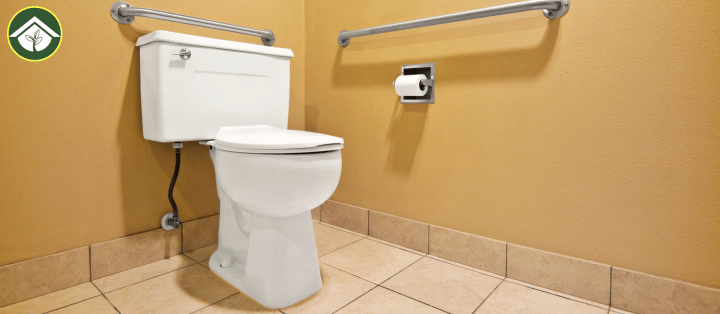
Independence in the bathroom is one of the most deeply personal aspects of daily life. For seniors, people with disabilities, and individuals recovering from surgery or injury, an ordinary toilet can become one of the most physically challenging fixtures in the home. Getting down into a low seated position and then pushing back up puts significant strain on knees, hips, and core muscles — and for anyone with limited mobility, reduced strength, or balance concerns, this routine act carries real fall risk every single time. That is where the handicap toilet seat changes everything. From raised risers with padded armrests to portable models designed for travel, adjustable-height systems, and fully fitted units with back support, today’s accessible toilet seats are practical, dignified, and designed to restore independence without requiring a full bathroom renovation. This guide covers every type, every key feature, and everything you need to know to choose the right one for your home or care setting.
Handicap Toilet Seat — Types, Standards, and Who Benefits Most:
A handicap toilet seat is any toilet seat or seat riser specifically designed to increase accessibility, safety, and comfort for users with limited mobility, disability, or age-related physical challenges. These products range from simple clip-on seat risers that add a few inches of height, all the way to comprehensive systems that include armrests, back support panels, padded surfaces, and locking mechanisms.
Who Benefits from a Handicap Toilet Seat:
The primary users of handicap toilet seats include:
- Elderly adults experiencing reduced muscle strength, balance issues, or joint stiffness
- People with arthritis, hip or knee replacements, or other orthopedic conditions
- Individuals with physical disabilities affecting lower body strength or mobility
- Post-surgical patients recovering from hip, knee, or abdominal procedures
- Pregnant women in later stages of pregnancy when lowering to a standard height is difficult
- Bariatric users who need reinforced weight support beyond standard seat ratings
The CDC’s STEADI (Stopping Elderly Accidents, Deaths, and Injuries) program identifies the bathroom as one of the highest-risk areas in the home for older adults, with toilet transfers — sitting down and standing up — representing a significant portion of fall incidents. A properly selected handicap toilet seat directly addresses this risk.
ADA Standards and What They Mean for Home Accessible Toilet Seats:
Before exploring specific seat types, it helps to understand the accessibility benchmarks that inform good accessible toilet seat design. Under the Americans with Disabilities Act Standards for Accessible Design, toilet seats in compliant facilities must be positioned at a height of 17 to 19 inches from the finished floor to the top of the seat. Standard residential toilets typically measure 15 to 16 inches — a gap of one to four inches that has a significant impact on the effort required to sit and stand for users with limited lower body strength.
The U.S. Access Board’s technical guide for toilet rooms further specifies requirements for grab bars: side grab bars must be at least 42 inches in length, mounted between 33 and 36 inches above the floor, and rear grab bars must be at least 36 inches in length. These specifications provide the dimensional reference points that inform well-designed home handicap toilet accessories as well.
For residential retrofitting, the ADA standards serve as best-practice guidance rather than mandatory code (residential private homes are generally not required to comply with ADA), but they represent the strongest evidence base for what works biomechanically for people with mobility challenges.
Raised Handicap Toilet Seat for Seniors — Choosing the Right Height Increase:
The most fundamental function of a handicap toilet seat is adding height to bring the sitting surface into a range that reduces joint strain and fall risk. Raised toilet seat risers are available in increments that typically add 2, 3.5, 4.5, 5, or 6 inches above the existing seat surface.
Selecting the Right Rise:
The appropriate height increase depends on the user’s total toilet height need and their physical stature. The goal is to position the seat so that when seated, the user’s feet rest comfortably flat on the floor with knees at approximately a 90-degree angle — matching the ergonomic principle behind ADA’s 17-to-19-inch seat height standard. For most adults using a standard 15-inch toilet, a rise of 2 to 4.5 inches brings the seat into ADA-compliant comfort height range.
Taller users or those with hip replacement restrictions that limit hip flexion below 90 degrees may benefit from the higher end of available rise — 5 to 6 inches — to stay within their prescribed joint angle limits during toilet transfers.
Handicap Toilet Seat with Armrests — Safety, Independence, and Support:
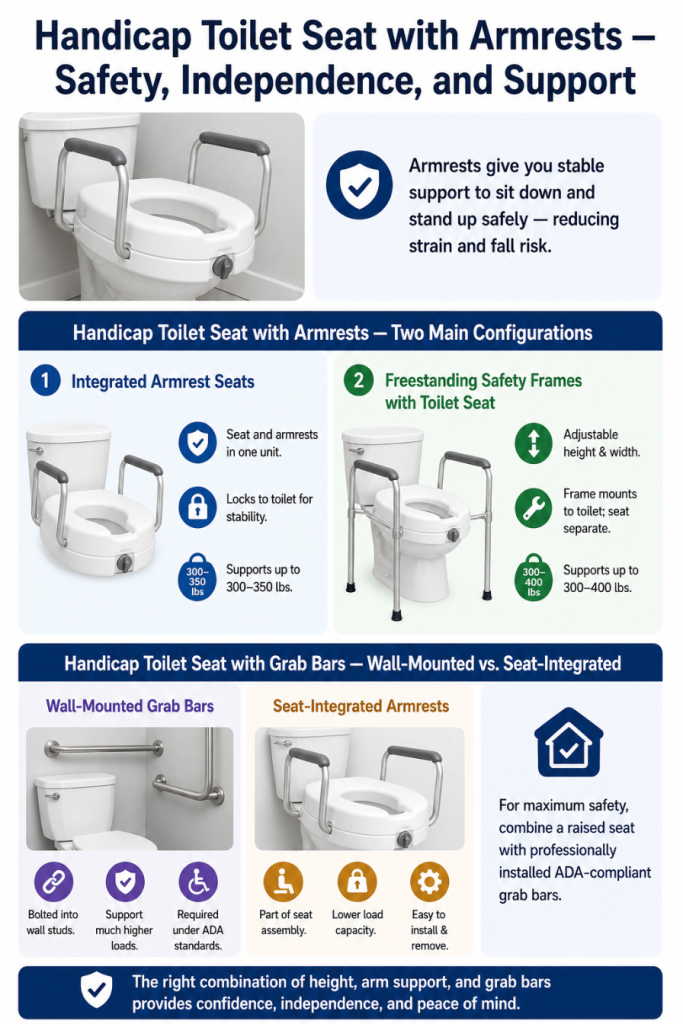
Armrests are the single feature that most transforms a raised toilet seat from a simple height adjustment into a true safety device. Padded or foam-covered armrests provide the user with fixed leverage points to lower themselves down and push back up to standing — dramatically reducing the physical demand on leg muscles and the risk of a fall during transfer.
Handicap Toilet Seat with Armrests — Two Main Configurations:
Integrated Armrest Seats:
These units combine the raised seat and the armrests into a single assembly. They typically sit over the existing toilet bowl and are secured with a locking mechanism at the front. Integrated models tend to be more stable as a unit and are easier to deploy quickly. Many feature padded armrests at a standard height and are designed to accommodate users up to 300 to 350 pounds.
Freestanding Safety Frames with Toilet Seat:
These separate the support structure from the seat riser. An aluminum or steel frame mounts to the toilet bowl with an adjustable bracket, while the arms extend up and forward on either side of the user. Safety frames offer adjustable arm height (commonly 26 to 32 inches above the floor) and adjustable arm width, making them highly customizable for users of different body sizes. Many support users up to 300 to 400 pounds and can be configured independently of the seat itself.
Handicap Toilet Seat with Grab Bars — Wall-Mounted vs. Seat-Integrated:
It is important to distinguish between armrests that are part of the seat assembly and permanent wall-mounted grab bars. Wall-mounted grab bars — the type required under ADA standards — are bolted directly into wall studs and can support significantly higher loads than freestanding seat-mounted arms. For users who will be transferring from a wheelchair or who require maximum support, professional installation of ADA-compliant grab bars alongside a raised seat provides the most robust accessible toilet setup available in a residential bathroom.
Adjustable Handicap Toilet Seat Height — Why Flexibility Matters:
Fixed-height raised seats work well for permanent installations where one user’s needs are consistent. However, households where multiple people use the same bathroom, or where a user’s rehabilitation is ongoing and their height needs may change, benefit greatly from adjustable-height handicap toilet seats.
These systems use telescoping legs, multi-position locking brackets, or modular stacking risers that allow the seat height to be changed without replacing the entire unit. Some models offer seven or more height adjustment positions, spanning a total seat height range of 19 to 25 inches. The VEVOR adjustable raised toilet seat system, for example, offers a 350-pound weight capacity with aluminum frame construction and multiple height lock positions — illustrating how industrial-grade adjustability is now available in consumer-accessible formats.
Padded Handicap Toilet Seat for Comfort — When Material Selection Matters:
Standard raised toilet seat risers are typically molded from hard polypropylene plastic — durable and easy to clean, but potentially uncomfortable for users who spend extended periods seated due to constipation, digestive conditions, hemorrhoids, or general frailty. Padded handicap toilet seats address this directly with foam-cushioned sitting surfaces, often covered in waterproof vinyl or closed-cell foam that can be wiped clean.
Padding thickness varies by model, but meaningful comfort improvement typically begins at half an inch of foam and increases noticeably at one inch or more. For users who are incontinent or require frequent seat surface cleaning, look for seamless vinyl covers without exposed stitching where moisture can accumulate.
Handicap Toilet Seat with Back Support — Full Body Support During Transfers:
Users who lack core stability — including those with spinal cord injuries, neurological conditions, severe hip weakness, or post-surgical fatigue — may need more than armrests alone. Handicap toilet seats with back support add a contoured backrest panel that provides a surface to lean into during the seated position, reducing the energy expenditure of maintaining upright posture and improving safety for users who might otherwise lean or slide sideways.
Back-supported seats are also a key feature of combination commode and shower chair units that can be repositioned between the toilet, bedside, and shower as needed — providing a versatile accessibility solution with a single purchase.
Portable Handicap Toilet Seat Riser — Accessibility for Travel:
For users who need accessibility support outside their home bathroom — whether visiting family, staying in hotels, or traveling — portable handicap toilet seat risers provide a practical solution. Lightweight models made from polypropylene or aluminum-reinforced plastic weigh as little as 3 to 5 pounds while still supporting weight capacities of 250 to 300 pounds.
The key feature that makes a raised toilet seat truly portable is its locking mechanism: a good portable riser clips securely to any standard or elongated toilet bowl without tools, holds firmly during use, and releases in seconds for packing. Many portable models fold or disassemble to fit in a standard travel bag or airline carry-on.
Universal Handicap Toilet Seat Fit — Compatibility with Round and Elongated Bowls:
One of the most common compatibility questions when selecting any raised toilet seat is whether it will fit the home’s specific toilet bowl. Most raised handicap seats are designed to fit both round (approximately 16.5 inches from bolt holes to front edge) and elongated (approximately 18.5 inches) bowls, either through a universal fit design or by including adapters for both bowl shapes.
Always verify the manufacturer’s stated fit compatibility before purchasing. Key dimensions to check include:
- Bowl length compatibility: Confirm the seat fits your bowl shape (round or elongated)
- Bolt hole spacing: Standard North American bolt spread is 5.5 inches center-to-center
- Weight capacity: Ensure the rated capacity exceeds the user’s weight, ideally with a 25% safety margin
- Locking mechanism type: Assess whether a front clamp, under-bowl bracket, or floor-contact frame is appropriate for your toilet model
Lightweight Handicap Toilet Seat for Travel — What to Look For:
A lightweight portable handicap toilet seat should weigh no more than 4 to 6 pounds in its carrying configuration, assemble without tools, and include non-slip feet or pads that protect the toilet bowl rim from scratching. Many portable models are constructed from high-density polyethylene or reinforced polypropylene that achieves an excellent ratio of light weight to structural strength.
For travel, it is worth verifying whether your destination bathrooms — hotels, hospitals, family homes — have standard or elongated bowls, as this affects which portable seat will fit reliably. A universal-fit portable model eliminates this uncertainty.
Frequently Asked Questions:
What is a handicap toilet seat and who needs one?
A handicap toilet seat is a toilet seat or seat-riser system designed to improve accessibility, safety, and comfort for users with limited mobility, disability, or age-related physical challenges. Users include elderly adults, people with arthritis or joint replacements, post-surgical patients, individuals with physical disabilities, and bariatric users requiring reinforced weight support. The primary purpose is to reduce the physical demand and fall risk associated with toilet transfers — sitting down and standing back up.
What height should a handicap toilet seat be?
According to the ADA Standards for Accessible Design, the seat surface of an accessible toilet should be between 17 and 19 inches from the finished floor. Standard residential toilets measure 15 to 16 inches. A raised seat riser adding 2 to 4.5 inches to a standard toilet brings the seat into ADA comfort height range for most adults. Taller users or those with hip replacement joint angle restrictions may benefit from a higher rise.
How do handicap toilet seat armrests help with safety?
Armrests provide fixed leverage points on either side of the user, allowing them to lower themselves down and push back up to standing using their arms rather than relying solely on leg and hip muscle strength. This dramatically reduces the physical demand of toilet transfers and the risk of falling. Padded armrests add grip comfort and reduce fatigue during longer sits. They are particularly important for users with arthritis, hip or knee replacements, or neurological conditions affecting lower body strength.
What is the weight limit on a handicap toilet seat?
Standard raised handicap toilet seats typically carry weight ratings of 250 to 350 pounds. Bariatric or heavy-duty models are available with ratings of 400 to 800 pounds or more, featuring reinforced frames, wider seat surfaces, and heavier-duty hardware. Always select a seat whose rated weight capacity exceeds the user’s body weight by at least 20 to 25 percent to maintain a safety margin during dynamic loading — for example when someone pushes up quickly from the seat.
Can a handicap toilet seat be used on both round and elongated toilets?
Most handicap toilet seats and raised risers are designed in universal-fit configurations that accommodate both round (16.5-inch) and elongated (18.5-inch) bowls. Some models are sold in round-only or elongated-only versions. Always check the manufacturer’s stated compatibility before purchasing, and verify your toilet bowl shape and bolt hole spacing (standard is 5.5 inches center-to-center) to ensure correct fit.
What is a portable handicap toilet seat riser and how does it work?
A portable handicap toilet seat riser is a lightweight raised toilet seat designed to be installed and removed without tools, making it suitable for use in different bathrooms or while traveling. It clips or clamps to the toilet bowl rim via a front locking mechanism, adds height and sometimes armrest support, and releases quickly for packing. Good portable models weigh 3 to 6 pounds while supporting 250 to 300 pounds and fit in a standard travel bag.
What is the difference between a handicap toilet seat with armrests and a toilet safety frame?
A handicap toilet seat with armrests is a self-contained unit where the seat riser and arms are integrated into one assembly that sits over the toilet. A toilet safety frame is a separate structure — typically aluminum — that mounts to the toilet bowl with a bracket and provides adjustable-height arms independently of the seat itself. Safety frames offer more adjustability (arm height, arm width) and typically provide more secure support for users performing wheelchair-to-toilet transfers.
Are grab bars the same as toilet seat armrests?
No. Grab bars are wall-mounted fixtures bolted directly into wall studs or blocking, capable of supporting 250 pounds or more as required by ADA standards. Armrests on raised toilet seats are attached to the seat unit itself and derive their stability from the seat’s connection to the toilet bowl rim. For maximum safety — particularly for wheelchair users or users with very limited mobility — combining a raised seat with armrests AND professionally installed wall grab bars provides the most comprehensive accessible toilet setup.
Does Medicare or insurance cover handicap toilet seats?
Medicare Part B may cover raised toilet seats and toilet safety equipment when they are classified as Durable Medical Equipment (DME) and prescribed by a physician as medically necessary. Coverage eligibility and reimbursement amounts vary depending on the specific product and the patient’s diagnosis and documentation. For guidance, contact your healthcare provider about obtaining a written prescription and check with your insurer or Medicare plan about your DME benefit. The Medicare.gov DME coverage guide provides an overview of covered categories.
How do I install a raised handicap toilet seat?
Most raised handicap toilet seats install without tools in under five minutes. Remove the existing toilet seat by unscrewing the mounting bolts at the rear. Place the raised seat over the bowl, ensuring it is centered. Tighten the front locking clamp by hand until the seat is secure against the bowl rim. For safety frame models, slide the bracket under the bowl rim, tighten with the included hardware, and adjust arm height and width to the user’s comfort. Test stability by applying firm downward and lateral pressure before first use.
What features should I look for in a handicap toilet seat for the elderly?
For elderly users, the most important features are appropriate height increase (bringing the seat to 17–19 inches from the floor), padded armrests for safe transfer leverage, a secure locking mechanism that prevents the seat from shifting, non-slip pads on any surface contacting the toilet rim or floor, and sufficient weight capacity for the user. Additional features like padded seat cushions, back support, and soft-close lids improve comfort for daily long-term use. Lightweight materials that the user or a caregiver can remove for cleaning are also important.
Can a handicap toilet seat be used as a portable commode?
Some combination models function as both a raised toilet seat riser and a freestanding bedside commode with a removable waste bucket. These 3-in-1 or multi-function units can sit over the toilet as a seat riser, stand independently beside the bed as a commode, or serve as a shower chair. This versatility makes them particularly valuable for users whose accessibility needs span multiple settings in the home or who require nighttime toileting access without navigating to the bathroom.
How do I clean a padded handicap toilet seat?
Padded handicap toilet seats should be cleaned regularly with warm water and mild soap or a standard bathroom disinfectant spray. The waterproof vinyl or closed-cell foam covers on padded models can be wiped down without absorbing liquids. Avoid bleach-based sprays directly on vinyl as they can degrade the material over time. For models with removable armrests or seat pads, detach components where possible for thorough cleaning of all surfaces including the underside and hinge area.
What is back support on a handicap toilet seat and who needs it?
A back support panel is a contoured or padded backrest attached to the rear of the seat assembly, providing a surface for the user to lean against during use. It reduces the energy demand of maintaining an upright seated posture — important for users with core weakness, spinal conditions, neurological impairments, or severe fatigue. Back support is also a standard feature on combination commode-shower chair units. Users who can maintain upright seated posture without effort typically do not require it, but for those who cannot, it is an important safety and comfort feature.


Leave a Reply