Every time you step into a public restroom, a familiar anxiety creeps in — is this toilet seat safe? It’s one of the most common health concerns people carry into daily life, yet one of the least understood. The truth about what diseases you can get from a toilet seat sits somewhere between urban myth and legitimate microbiology. Yes, toilet seats host a measurable community of bacteria and viruses. But the real question is: under what circumstances can they actually make you sick? This guide cuts through the fear and the folklore to give you an evidence-based understanding of the actual risks — and what you can do to protect yourself.
What Diseases Can You Get from a Toilet Seat — and How Real Is the Risk?
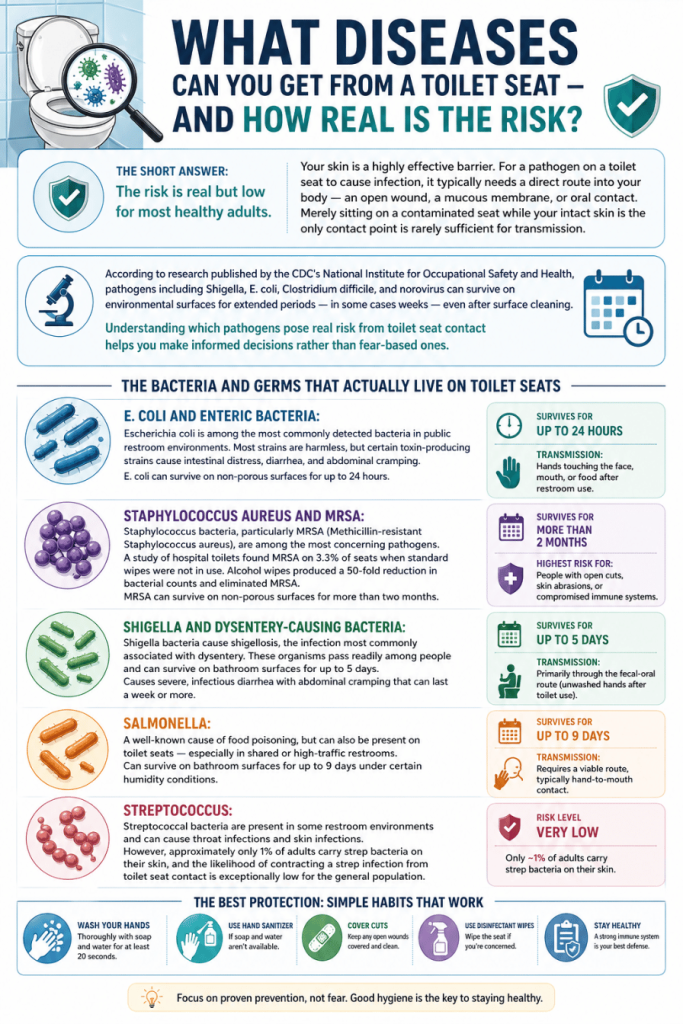
The short answer: the risk is real but low for most healthy adults. Your skin is a highly effective barrier. For a pathogen on a toilet seat to cause infection, it typically needs a direct route into your body — an open wound, a mucous membrane, or oral contact. Merely sitting on a contaminated seat while your intact skin is the only contact point is rarely sufficient for transmission.
That said, certain bacteria and viruses are more resilient than others. According to research published by the CDC’s National Institute for Occupational Safety and Health, pathogens including Shigella, E. coli, Clostridium difficile, and norovirus can survive on environmental surfaces for extended periods — in some cases weeks — even after surface cleaning.
Understanding which pathogens pose real risk from toilet seat contact helps you make informed decisions rather than fear-based ones.
The Bacteria and Germs That Actually Live on Toilet Seats:
E. coli and Enteric Bacteria:
Escherichia coli is among the most commonly detected bacteria in public restroom environments. Most strains of E. coli are harmless residents of the human gut, but certain toxin-producing strains cause intestinal distress, diarrhea, and abdominal cramping. Research published in peer-reviewed microbiology journals confirms that E. coli can survive on non-porous surfaces for up to 24 hours, making it one of the more persistent threats on toilet seats.
Transmission requires the bacteria to travel from the seat to a route of entry — most commonly the hands touching the face, mouth, or food after restroom use. This is why handwashing, not hovering above the toilet, is the single most effective prevention measure.
Staphylococcus aureus and MRSA:
Staphylococcus bacteria, particularly the antibiotic-resistant strain known as MRSA (Methicillin-resistant Staphylococcus aureus), are among the most concerning pathogens found on toilet surfaces. According to research published in a National Institutes of Health database, a study of hospital toilets found MRSA present on 3.3% of seats when standard wipes were not in use. Notably, use of alcohol wipes produced a 50-fold reduction in bacterial counts and eliminated MRSA from tested surfaces.
MRSA can survive on non-porous surfaces like toilet seats for more than two months. The risk of transmission is highest for people with open cuts, skin abrasions, or compromised immune systems. The CDC identifies MRSA as a significant community health concern, particularly in shared-use environments.
Shigella and Dysentery-Causing Bacteria:
Shigella bacteria are responsible for shigellosis, the infection most commonly associated with dysentery. These organisms pass readily among people and have been demonstrated to survive on bathroom surfaces for up to 5 days. Shigellosis causes severe, infectious diarrhea with abdominal cramping that can last a week or more. The bacteria spread primarily through the fecal-oral route — meaning unwashed hands after toilet use are the main transmission vector rather than direct seat contact.
Salmonella:
Salmonella is a well-known cause of food poisoning, but it can also be present on toilet seats — particularly in shared or high-traffic restrooms. According to academic research published in the Journal of Applied Microbiology, Salmonella has been demonstrated to survive on bathroom surfaces for up to 9 days under certain humidity conditions. Like E. coli, transmission from a toilet seat to a human host requires a viable route — typically hand-to-mouth contact — making post-restroom handwashing essential.
Streptococcus:
Streptococcal bacteria are present in some restroom environments and can cause throat infections and skin infections. However, approximately only 1% of adults carry strep bacteria on their skin, and the likelihood of contracting a strep infection from toilet seat contact is exceptionally low for the general population.
The Viruses That Can Survive on Toilet Seats:
Norovirus — The Most Persistent Threat:
Among all the pathogens that commonly contaminate toilet seats, norovirus is arguably the most concerning for the average person. Often called the “stomach bug,” norovirus causes vomiting and diarrhea and is highly contagious. What makes it particularly relevant to toilet hygiene is its exceptional surface durability: norovirus has been found contaminating non-porous surfaces, including toilet seats, for as long as two weeks — even after cleaning attempts.
A quantitative microbial risk assessment published in the PMC database confirmed that norovirus transmission risk from toilet seat fomite contact is measurable, though hand sanitizer use after restroom exit significantly reduced infection probability across all scenarios tested.
Influenza Viruses:
The majority of influenza virus strains can survive on non-porous surfaces for approximately 2–3 days, making toilet seats a potential — if uncommon — point of contact. Most flu transmission occurs through respiratory droplets or hand-to-face contact after touching contaminated surfaces rather than direct seat-to-skin infection.
Hepatitis A:
Hepatitis A is a viral infection spread through the fecal-oral route, and the virus can survive on surfaces for extended periods. The World Health Organization recognizes fecal contamination of surfaces as a transmission pathway for hepatitis A, making contaminated toilet seats a theoretical — if uncommon — risk in settings with poor sanitation.
Fungal Infections and Parasites — An Overlooked Category:
Ringworm and Dermatophyte Fungi:
Fungi such as dermatophytes thrive in warm, moist environments. If a toilet seat is used by someone with an active fungal infection and the conditions are favorable (high humidity, damp surface), there is a small chance of transmission — particularly for infections like ringworm.
Trichomoniasis — A Rare but Real Exception:
Among sexually transmitted parasites, trichomoniasis (Trichomonas vaginalis) is the one most documented to have some surface-survival capacity. According to research cited by the Indian Journal of Sexually Transmitted Diseases and AIDS and referenced by public health authorities, trich parasites can survive for several hours on damp or moist surfaces including toilet seats. However, for transmission to occur, the genital area would need to come into direct contact with the parasite within a very short window of time — making this an extremely rare real-world occurrence.
The STD Myth — What the CDC and Experts Actually Say:
Can You Get an STD from a Toilet Seat?
This is perhaps the most widespread toilet seat health myth. The answer, for nearly every STD, is effectively no. The CDC explicitly states that herpes cannot be contracted from toilet seats, and that HIV is not transmitted through casual surface contact. Bacterial STDs — including gonorrhea, chlamydia, and syphilis — cannot survive outside the body’s mucous membranes. They die almost immediately upon contact with a cold, dry surface like a toilet seat.
As one physician quoted by Hackensack Meridian Health noted, there is “virtually zero chance” of contracting an STD from a toilet seat. Even viral STDs like herpes simplex virus are not stable outside the body long enough to present a meaningful transmission risk through casual toilet contact.
Can You Get a UTI from a Toilet Seat?
Urinary tract infections (UTIs) are most commonly caused by bacteria from within your own body — primarily E. coli from your digestive system — rather than from external surfaces. Since the urethra does not come into direct contact with the toilet seat during normal use, the transmission route is essentially absent. However, poor wiping habits or inadequate hygiene after using a contaminated restroom could theoretically introduce bacteria to the genital-urinary area.
How Likely Are You to Get an Infection from a Public Toilet Seat?
For the average healthy adult, the risk of infection from sitting on a public toilet seat is very low. Your skin provides a highly effective barrier. The pathogens that present the greatest risk — norovirus, MRSA, E. coli — primarily infect through hand-to-face transmission after touching contaminated surfaces, not through skin-seat contact.
The risk is meaningfully elevated for people who are immunocompromised, have open wounds or skin abrasions on the thighs or buttocks, are very young or elderly, or use restrooms in healthcare environments where antibiotic-resistant bacteria are more prevalent. In these populations, the precautions outlined below take on greater importance.
How to Avoid Infections from Toilet Seats — Practical Steps That Actually Work:
The most evidence-supported behaviors for reducing restroom infection risk are straightforward:
Wash your hands thoroughly. The CDC recommends at least 20 seconds of soap-and-water handwashing after restroom use. This single behavior prevents more disease transmission than any other restroom hygiene measure. Research shows proper handwashing can reduce diarrheal illness in immunocompromised individuals by up to 58%.
Use a disinfectant wipe on the seat. Alcohol-based wipes have been demonstrated in clinical research to achieve a 50-fold reduction in bacterial counts on toilet surfaces. This is particularly valuable in healthcare settings and for immunocompromised individuals.
Close the lid before flushing. This addresses the “toilet plume” phenomenon — research reviewed by the CDC confirms that flushing generates bioaerosols containing fecal bacteria and viruses, which can contaminate surrounding surfaces and remain airborne.
Use hand sanitizer after exiting. Even when hands are washed inside the restroom, touching the exit door handle creates a new contamination event. Quantitative risk assessment research found that hand sanitizer use after exiting significantly reduced infection probability for norovirus, adenovirus, and SARS-CoV-2.
Cover open wounds. Keep any cuts or abrasions on the skin covered when using shared restrooms, as these represent the most viable route for bacterial transmission from surfaces.
Frequently Asked Questions:
Can you catch diseases from a toilet seat?
Yes, certain diseases can theoretically be transmitted via a toilet seat, but for the vast majority of healthy adults, the risk is very low. Pathogens including norovirus, E. coli, Salmonella, MRSA, and Shigella have been detected on toilet seats in research settings. However, intact human skin acts as an effective barrier, and most transmission in restroom environments occurs through hand contact with contaminated surfaces followed by touching the face, not through direct seat-to-skin infection.
What infections can you get from a toilet seat?
The infections most plausibly associated with toilet seat contact include norovirus (gastroenteritis), E. coli and Salmonella gastroenteritis, Shigella (dysentery), MRSA skin infections (particularly in people with open wounds), and dermatophyte fungal infections in warm, moist conditions. In very rare circumstances, the parasitic STI trichomoniasis may survive briefly on a damp seat. Most other infections attributed to toilet seats are not supported by clinical evidence.
Are toilet seats a source of bacterial infections?
Research confirms that toilet seats host measurable populations of bacteria including E. coli, Staphylococcus aureus, MRSA, Salmonella, Shigella, and Streptococcus. However, the presence of bacteria on a surface does not automatically equate to infection risk. Transmission requires a viable route into the body — typically through broken skin, mucous membrane contact, or fecal-oral transmission via unwashed hands. Regular cleaning and good hand hygiene dramatically reduce the bacterial burden and associated risk.
Can you get an STD from a toilet seat?
For virtually all sexually transmitted diseases, the answer is no. Bacterial STDs like gonorrhea, chlamydia, and syphilis cannot survive on cold, dry surfaces. Viral STDs including HIV, HSV-1, and HSV-2 die rapidly outside the human body. The CDC explicitly states that herpes is not transmitted via toilet seats. Trichomoniasis is a narrow exception — it can theoretically survive on a damp seat for several hours — but real-world transmission via this route remains extremely rare and would require near-immediate genital contact with the freshly contaminated seat.
How likely are you to get an infection from a public toilet seat?
The probability for a healthy adult is very low. Your skin is an effective pathogen barrier, and most restroom infections occur through hands rather than the seat itself. Studies using quantitative microbial risk assessment models confirm that infection probability from a single toilet seat contact is generally below meaningful clinical thresholds, particularly when followed by proper handwashing and hand sanitizer use. Immunocompromised individuals, those with open skin wounds, and hospital patients face elevated — though still manageable — risk.
What germs live on toilet seats?
Research consistently identifies the following pathogens on public toilet seats: E. coli, Salmonella, Shigella, Staphylococcus aureus (including MRSA), Streptococcus, norovirus, influenza viruses, hepatitis A virus, and in healthcare environments, Clostridium difficile and vancomycin-resistant Enterococcus (VRE). A study published in Applied and Environmental Microbiology detected genetic traces of more than 77,000 distinct bacterial and viral types in public restroom environments, though only a fraction of these pose realistic infection risk.
Can you get a urinary tract infection from a toilet seat?
A UTI acquired directly from a toilet seat is highly unlikely. The urethra does not come into direct contact with the toilet seat during normal use, eliminating the primary transmission route. Most UTIs originate from bacteria — primarily E. coli — already present within the individual’s own gut flora, not from external environmental surfaces. Where restrooms can contribute to UTI risk is indirectly: inadequate handwashing or poor wiping technique after using a contaminated restroom can introduce bacteria to the genital area.
Can you get herpes from a toilet seat?
No. The herpes simplex virus (HSV) is highly unstable outside the human body. Research has shown that HSV combined with bodily fluids cannot survive at room temperature for longer than approximately 30 minutes. The CDC’s own guidance is unambiguous: “You will not get herpes from toilet seats.” There are no documented clinical cases of herpes transmission via toilet seat contact, and medical authorities including the Mayo Clinic confirm that the risk is negligible to nonexistent.
Can you get norovirus or E. coli from a toilet seat?
These are the two pathogens most plausibly associated with toilet seat transmission. Norovirus can survive on non-porous surfaces like toilet seats for up to two weeks — even after surface cleaning — and causes highly unpleasant gastrointestinal illness. E. coli can survive on surfaces for up to 24 hours. However, in both cases, infection most commonly occurs when contaminated hands touch the mouth or food, rather than directly through the seat. Closing the toilet lid before flushing and thorough handwashing are the most effective preventive steps.
How to avoid infections from toilet seats?
The most effective steps are: (1) wash your hands with soap and water for at least 20 seconds after every restroom visit; (2) use a disinfectant wipe on the seat before sitting; (3) close the toilet lid before flushing to prevent aerosol contamination; (4) use hand sanitizer (minimum 60% alcohol) after touching the door on the way out; (5) avoid touching your face until your hands are clean; and (6) cover any open cuts or skin wounds before entering shared restroom facilities. Seat covers made of paper provide limited protection as paper is porous, but they do offer psychological comfort and minor physical separation.
Should immunocompromised people take extra precautions in public restrooms?
Yes. Clinical research conducted in hospital settings — particularly a study at a children’s cancer hospital published in peer-reviewed infectious disease literature — found that immunocompromised patients face a meaningfully elevated risk from toilet seat pathogens including MRSA. For this population, consistent use of alcohol wipes on toilet seats, strict handwashing protocols, and avoidance of high-traffic public restrooms when possible are all evidence-supported precautions.
Does flushing the toilet increase infection risk?
Yes, in a specific way known as the “toilet plume” effect. When a toilet is flushed without the lid closed, it generates a fine aerosol of water droplets containing fecal bacteria and viruses. Research reviewed by the CDC confirms that these aerosols can contaminate surrounding surfaces and remain airborne. Pathogens including norovirus, E. coli, and Clostridium difficile have been associated with toilet plume dispersion. Simply closing the toilet lid before flushing is one of the most underutilized and effective restroom hygiene habits available.
Is it safer to use a toilet seat cover or to hover above the seat?
Neither is as effective as good handwashing. Toilet seat covers are made of porous paper, which limits their effectiveness as a microbial barrier. Hovering, meanwhile, requires muscular effort and is not always practical. For the average healthy adult, sitting on a wiped-down seat carries a very low infection risk. Wiping the seat with a disinfectant wipe before use — combined with thorough handwashing afterward — is more protective than either covering or hovering. The hands, not the seat, are the primary infection vector in most restroom environments.
Are home toilet seats safer than public ones?
Generally yes, though perhaps less so than most people assume. A study of household restrooms found that faecal coliforms were detected on bathroom surfaces in 8 out of 20 homes after residents’ regular cleaning routines. Home toilets benefit from fewer users and more frequent personal cleaning, but shared household restrooms — particularly during gastrointestinal illness in a family member — can harbor significant levels of norovirus and other pathogens. Disinfecting toilet surfaces regularly with an EPA-registered disinfectant, and always washing hands after use, applies equally at home and in public.
For official guidance on handwashing, surface disinfection, and infection prevention, refer to the CDC’s Handwashing Resources, the WHO’s guidelines on sanitation and hygiene, and your local public health authority.


Leave a Reply