The idea that you could catch a venereal disease — or any sexually transmitted infection — from sitting on a toilet seat is one of the most persistent myths in public health. It circulates through schools, workplaces, and online discussions with remarkable durability, despite being consistently and thoroughly contradicted by medical science. This widespread anxiety affects behavior, shapes attitudes toward public restrooms, and sometimes even causes people to avoid necessary medical facilities out of misplaced fear. The reality, backed by decades of epidemiological research and the firm consensus of every major health authority, is straightforward: the bacteria and viruses that cause venereal diseases are biologically unsuited to survive on toilet seats long enough or in the right conditions to infect another person through ordinary restroom use. Understanding exactly why that is — for syphilis, gonorrhea, chlamydia, and other common STIs — is the clearest path to replacing fear with accurate knowledge.
Can You Get Venereal Disease from a Toilet Seat — What Every Major Health Authority Confirms:
Every credible public health institution that has examined this question has arrived at the same conclusion. The Centers for Disease Control and Prevention (CDC) explicitly states that the bacteria responsible for syphilis cannot be contracted through casual contact with a toilet seat. The UK’s National Health Service (NHS) similarly confirms that bacterial STIs including chlamydia are not transmitted through toilet seats, door handles, swimming pools, or similar environmental surfaces. These are not cautious hedges or oversimplifications — they reflect the biological reality of how these pathogens survive and spread.
The core reason is straightforward: the organisms that cause venereal diseases — whether bacterial or viral — evolved to live inside the warm, moist, nutrient-rich environment of human mucous membranes. Outside that environment, on a cold, dry, hard surface like a plastic or porcelain toilet seat, they degrade rapidly and lose the ability to cause infection. The gap between theoretical presence on a surface and practical transmission risk is enormous — and in the case of venereal diseases and toilet seats, no documented case of transmission through this route has ever been recorded anywhere in the medical literature.
How Venereal Diseases Are Actually Transmitted — The Biology That Matters:
The Mucous Membrane Requirement:
All of the classic venereal diseases — syphilis, gonorrhea, and chlamydia — are transmitted through contact between an infected person’s mucous membranes or bodily fluids and a susceptible person’s mucous membranes. Mucous membranes are the moist tissue linings found in the genitals, rectum, urethra, cervix, mouth, and throat. These tissues are far more permeable to bacterial and viral entry than the dry, keratinized outer skin of the thighs or buttocks — the body parts that actually contact a toilet seat.
For infection to occur, the pathogen must reach this susceptible tissue in a viable state and in sufficient quantities. Sitting on a toilet seat involves the outer thighs, buttocks, and perineal skin — not mucous membranes. This anatomical reality is as important as any question about pathogen survival time.
Sexual Transmission Routes:
According to the CDC’s STI information pages, venereal diseases spread through:
- Vaginal, anal, and oral sex without barrier protection
- Genital skin-to-skin contact even without penetration (relevant for conditions like genital herpes and HPV)
- Sharing sex toys without cleaning between uses
- Mother-to-child transmission during childbirth for several STIs
None of these routes involves incidental contact with a toilet seat or other bathroom surface during ordinary restroom use.
Can You Get Syphilis from a Toilet Seat:
Syphilis is caused by the bacterium Treponema pallidum, a fragile spiral-shaped organism that is one of the most environmentally sensitive pathogens in the STI category. The CDC’s syphilis fact sheet is explicit: syphilis cannot be contracted through casual contact, including toilet seats, door handles, swimming pools, hot tubs, or shared clothing. The bacterium requires direct contact with an active syphilitic lesion (chancre or mucous patch) to transmit, and it dies almost immediately upon exposure to air and ambient surface conditions.
A systematic review of pathogen survival on surfaces published through the National Institutes of Health (NIH) confirms that Treponema pallidum does not appear in surface survival data at all — because it does not survive meaningful contact with environmental surfaces. This makes syphilis one of the pathogens for which toilet seat transmission is most clearly impossible even at a theoretical level.
Can You Get Gonorrhea from a Toilet Seat:
Gonorrhea is caused by the bacterium Neisseria gonorrhoeae, which lives in the mucous membranes of the urethra, vagina, rectum, and throat. According to Healthline’s medically reviewed STI guide, these bacteria cannot survive in air or on hard surfaces — they require the specific warm, moist environment of human tissue to remain viable.
Laboratory studies have noted that Neisseria gonorrhoeae bacteria can survive on some surfaces for limited periods under controlled conditions — the NIH surface survival review data notes detection on surfaces for one to three days under specific laboratory conditions. However, laboratory persistence under optimal humidity and temperature conditions is not the same as the ability to cause infection through casual toilet seat contact. The CDC and all major health authorities remain consistent: gonorrhea is transmitted through sexual contact, not through toilet seats.
Can You Get Chlamydia from a Toilet Seat:
Chlamydia, caused by Chlamydia trachomatis, is the most commonly reported bacterial STI in the United States. According to the CDC’s 2024 provisional STI surveillance data, there were still more than 2.2 million combined STI cases reported in 2024, with chlamydia representing the largest single category. Despite this prevalence, not a single case has been attributed to toilet seat transmission.
The NHS confirms that chlamydia is not transmitted through toilet seats, and medical analysis consistently shows that chlamydia bacteria die within minutes to hours on hard, dry surfaces. For transmission to occur via a toilet seat, infected bodily fluid would need to be deposited on the seat surface, remain viable, contact the next user’s mucous membranes directly within a very short window, and do so in sufficient quantity to cause infection — a chain of events that epidemiology has never documented as producing an actual case.
Can You Get Genital Warts from a Toilet Seat:
Genital warts are caused by specific strains of Human Papillomavirus (HPV). As covered by the American Cancer Society, HPV spreads through intimate skin-to-skin contact and is not transmitted through contact with toilet seats or other environmental surfaces. No documented cases of genital wart transmission through toilet seat contact exist in the medical literature, and the biological conditions required for HPV to establish infection — direct contact with susceptible mucous membranes or microabraded skin — are not met through ordinary toilet seat use.
Can Venereal Disease Spread on Bathroom Surfaces — Realistic Risk Assessment:
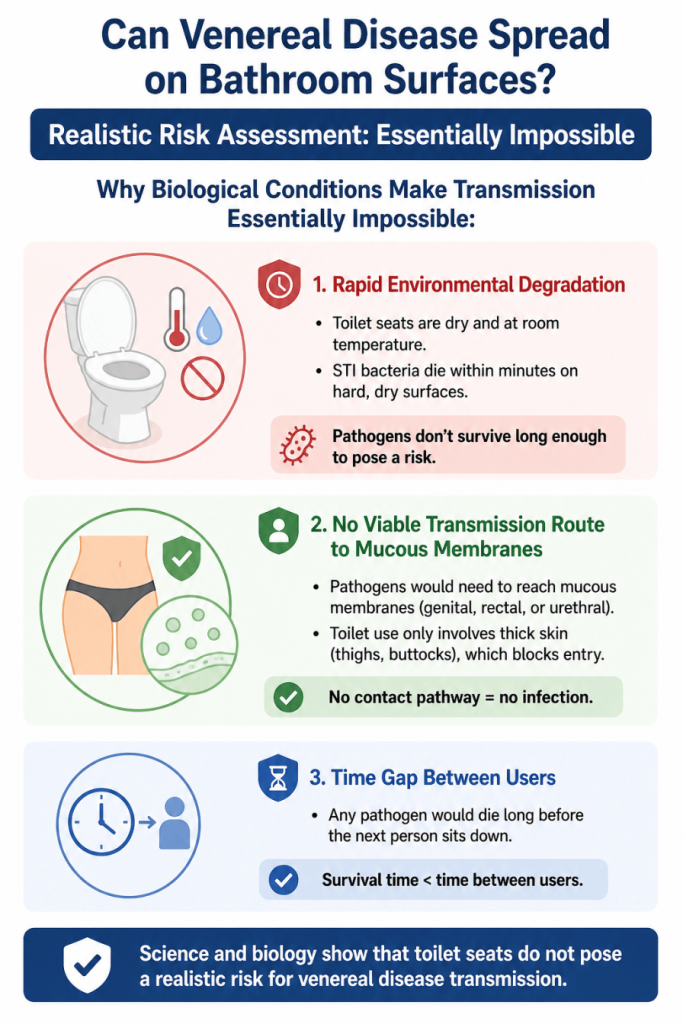
Why Biological Conditions Make Transmission Essentially Impossible:
Even where a pathogen may theoretically survive for a brief period on a surface, several biological barriers make toilet seat transmission of venereal disease essentially impossible in practice:
Rapid Environmental Degradation:
Bacterial STI pathogens require warm, moist conditions close to human body temperature to remain infectious. A toilet seat at ambient room temperature, often dry, provides none of these conditions. Chlamydia bacteria die within minutes on hard, dry surfaces. Gonorrhea bacteria are similarly fragile outside mucous membranes. Syphilis bacteria die almost immediately in open air.
No Viable Transmission Route to Mucous Membranes:
Even if a pathogen survived briefly on a toilet seat surface, it would need to travel from that surface to the user’s mucous membranes — genital, rectal, or urethral tissue — to cause infection. Ordinary toilet use does not create this contact pathway. The thighs and buttocks that contact the seat are covered in thick, keratinized skin that these pathogens cannot penetrate under normal circumstances.
Time Gap Between Users:
As the Medical News Today analysis notes, even in a theoretical scenario, the time gap between one user leaving and another sitting down is typically far longer than the survival window of any venereal disease pathogen on a dry surface.
Is It Safe to Use a Shared Toilet Seat for VD Risk:
Yes — from the specific perspective of venereal disease transmission, shared toilet seats pose no meaningful risk. This applies equally to public restrooms, workplace bathrooms, shared home bathrooms, and medical facility restrooms. No adjustment of behavior specific to VD risk is warranted when using a shared toilet.
This does not mean that public restrooms are entirely free of all hygiene considerations. Gastrointestinal bacteria, respiratory viruses, and fecal-oral pathogens are legitimate concerns in public restrooms — primarily associated with hand contact with surfaces and inadequate handwashing, not with the act of sitting on the toilet seat itself.
How to Reduce Venereal Disease Risk in Public Restrooms — What Actually Works:
The following measures are supported by evidence for reducing STI transmission risk — none of them involve toilet seat avoidance behaviors:
STI Vaccination:
The CDC recommends HPV vaccination for all children beginning at ages 11 to 12, with catch-up vaccination available through age 26 for those not previously vaccinated. Hepatitis B vaccination is also recommended as part of standard immunization schedules and provides protection against a bloodborne infection that can be sexually transmitted.
Consistent Barrier Method Use:
Correct and consistent use of condoms during vaginal, anal, and oral sex significantly reduces the transmission risk for gonorrhea, chlamydia, syphilis, HIV, and other STIs. No toilet seat hygiene practice provides any equivalent protection.
Regular STI Testing:
Because many STIs including chlamydia and gonorrhea produce no symptoms, regular screening is essential for sexually active individuals. The CDC recommends annual STI screening for sexually active adults with new or multiple partners. Testing allows early treatment and prevents onward transmission.
Hand Hygiene After Restroom Use:
While not specifically an STI prevention measure, thorough handwashing after using any restroom — public or private — remains the single most evidence-supported hygiene behavior for reducing transmission of gastrointestinal and respiratory illnesses that do spread through surface contact.
Frequently Asked Questions:
Can you get venereal disease from a public toilet seat?
No. The bacteria and viruses responsible for venereal diseases cannot survive on a toilet seat surface in conditions sufficient to cause infection through ordinary restroom use. The CDC, NHS, WHO, and all major health authorities confirm that VD transmission through toilet seat contact has never been documented and is not biologically plausible under normal restroom conditions.
Can you get syphilis from a toilet seat?
No. The CDC explicitly states that syphilis cannot be contracted through casual contact including toilet seats. The bacterium Treponema pallidum is one of the most environmentally fragile STI pathogens and dies almost immediately when exposed to air and surface conditions outside the human body.
Can you get gonorrhea from a toilet seat?
No. While Neisseria gonorrhoeae has been detected on surfaces under specific laboratory conditions, health authorities including the CDC uniformly confirm that gonorrhea is not transmitted through toilet seat contact. The bacteria live in mucous membranes and cannot survive or transfer to new hosts through ordinary toilet use.
Can you get chlamydia from a toilet seat?
No. The NHS and CDC both confirm that chlamydia is not transmitted through toilet seats. Chlamydia bacteria die within minutes on hard, dry surfaces, and even brief surface survival does not create a viable transmission pathway to the mucous membranes required for infection to occur.
Can you get genital warts from a toilet seat?
No documented cases of genital wart transmission through a toilet seat exist. Genital warts are caused by HPV strains that require intimate skin-to-skin contact for transmission. The biological conditions necessary for HPV to infect a new host are not present during ordinary toilet seat contact.
How are venereal diseases actually transmitted?
Venereal diseases spread through intimate contact between an infected person’s mucous membranes or bodily fluids and a susceptible person’s mucous membranes. This occurs primarily through vaginal, anal, and oral sex without barrier protection, through genital skin-to-skin contact, through sharing sex toys without cleaning, and in some cases through mother-to-child transmission during childbirth.
Can you get an STD from sitting on a toilet seat?
No. Every major health organization — including the CDC, WHO, NHS, and American Cancer Society — confirms that bacterial STIs including gonorrhea, chlamydia, and syphilis are not transmitted through toilet seat contact. The organisms responsible require mucous membrane contact and cannot survive on dry, hard surfaces in conditions sufficient to infect a new host.
How long do the bacteria that cause venereal disease survive outside the body?
Survival times vary by pathogen but are uniformly short. Treponema pallidum (syphilis) dies almost immediately outside the body. Neisseria gonorrhoeae (gonorrhea) and Chlamydia trachomatis (chlamydia) bacteria survive for minutes to a few hours at most on dry surfaces before losing infectiousness. Even under laboratory conditions with controlled humidity, these organisms degrade far too quickly to pose practical transmission risk through casual surface contact.
Is it safe to use a public toilet without a seat cover?
From a venereal disease perspective, yes. Toilet seat covers provide comfort and personal peace of mind but are not a public health measure for preventing STI transmission. No evidence supports toilet seat covers as a meaningful barrier against venereal disease. The CDC and public health guidance do not recommend them as an STI prevention measure.
Can venereal disease spread from shared towels or bathroom items?
Shared items that contact genital areas — such as towels or unwashed underwear — carry a higher theoretical risk than toilet seats because they may retain infected fluids in moist conditions. However, documented real-world transmission through shared towels remains exceptionally rare. The practical risk is still many orders of magnitude lower than transmission through sexual contact. Shared bathroom surfaces like faucet handles and door knobs pose no VD risk.
What are the real risks of using public restrooms?
The genuine hygiene concerns in public restrooms involve gastrointestinal and respiratory pathogens — not venereal diseases. Thorough handwashing after restroom use is the most evidence-supported behavior for reducing illness risk. Flushing with the toilet lid closed where available also reduces airborne fecal particle dispersal. Venereal disease risk is not affected by public restroom use behavior.
Who should get tested for venereal disease and how often?
The CDC recommends annual STI screening for all sexually active adults who have new or multiple partners. Sexually active women under 25 should be screened annually for chlamydia and gonorrhea. Pregnant women should be screened for syphilis, HIV, and hepatitis B. Men who have sex with men are recommended to screen every three to six months depending on activity level. Your healthcare provider can advise on the appropriate testing schedule for your individual circumstances.
Where can I find reliable information about STI prevention?
The most authoritative sources for STI and VD information include the CDC’s STI pages, the World Health Organization’s STI fact sheets, the NHS sexual health guidance, and the National Institutes of Health MedlinePlus. These resources are regularly updated and provide evidence-based guidance on prevention, testing, and treatment.


Leave a Reply