Every day, millions of people hesitate before sitting down in a public restroom. The thought creeps in almost automatically — what if someone left something behind? What if that toilet seat is harbouring something dangerous, something transmissible, something that could change your health forever? The fear is understandable. Public restrooms are not exactly known for their cleanliness. But when it comes to the specific question of whether you can get an STD from a toilet seat, medical science has a clear and reassuring answer — and it is almost certainly not what anxiety is telling you. Understanding the biology behind how sexually transmitted infections actually spread is not just interesting; it is genuinely empowering. Once you understand the facts, you can stop wasting energy on fears that have no basis in evidence, and focus instead on the sexual health practices that actually matter.
The Biology Behind STD Transmission — Why Toilet Seats Are Not the Problem:
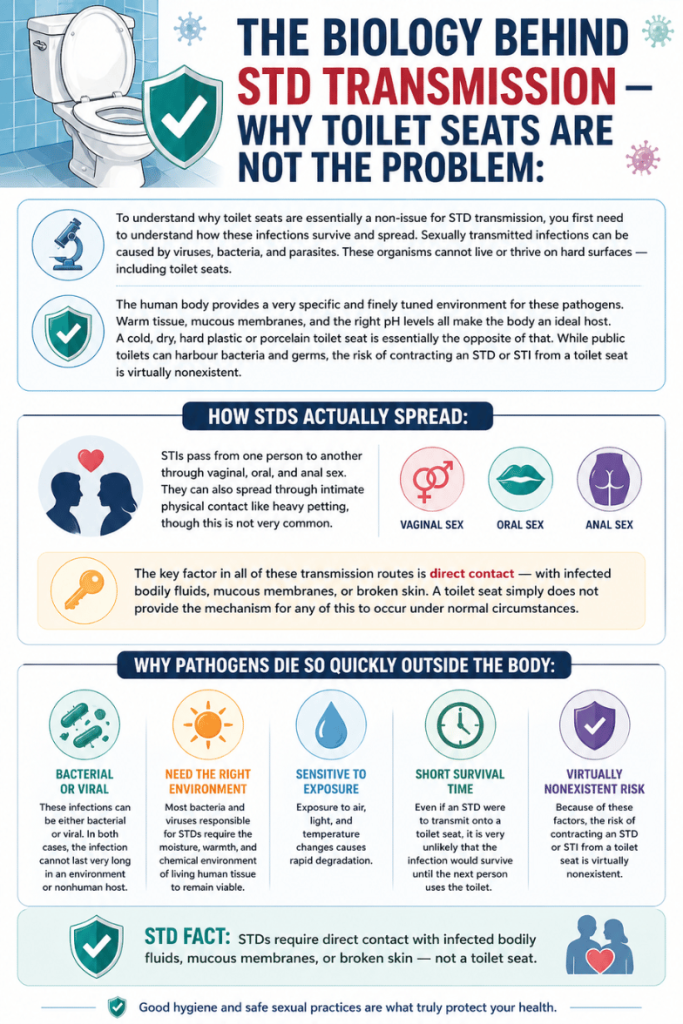
To understand why toilet seats are essentially a non-issue for STD transmission, you first need to understand how these infections survive and spread. Sexually transmitted infections can be caused by viruses, bacteria, and parasites. These organisms cannot live or thrive on hard surfaces — including toilet seats.
The human body provides a very specific and finely tuned environment for these pathogens. Warm tissue, mucous membranes, and the right pH levels all make the body an ideal host. A cold, dry, hard plastic or porcelain toilet seat is essentially the opposite of that. While public toilets can harbour bacteria and germs, the risk of contracting an STD or STI from a toilet seat is virtually nonexistent.
How STDs Actually Spread:
STIs pass from one person to another through vaginal, oral, and anal sex. They can also spread through intimate physical contact like heavy petting, though this is not very common. The key factor in all of these transmission routes is direct contact — with infected bodily fluids, mucous membranes, or broken skin. A toilet seat simply does not provide the mechanism for any of this to occur under normal circumstances.
Why Pathogens Die So Quickly Outside the Body:
These infections can be either bacterial or viral. In both cases, the infection cannot last very long in an environment or nonhuman host. For this reason, even if an STD were to transmit onto a toilet seat, it is very unlikely that the infection would survive until the next person uses the toilet. Most bacteria and viruses responsible for STDs require the moisture, warmth, and chemical environment of living human tissue to remain viable. Exposure to air, light, and temperature changes causes rapid degradation.
Can You Get Gonorrhea from a Toilet Seat — Breaking Down the Bacterial STDs:
Gonorrhoea is caused by the bacterium Neisseria gonorrhoeae, which lives specifically in the mucous membranes of the genitals, rectum, throat, and eyes. These bacteria live in the mucous membranes of the penis, vagina, rectum, and mouth. They cannot survive in air or on surfaces such as a toilet seat, making it virtually impossible for you to contract a bacterial STI in this way.
The same applies to chlamydia, another extremely common bacterial STI. Chlamydia, Gonorrhoea, Syphilis, Herpes, Trichomonas, HPV, and HIV all require direct skin-to-skin or body fluid contact for transmission. If an infected individual did happen to leave semen, vaginal secretions, blood, or saliva on a toilet seat, the organisms would then have to be present in sufficient numbers to cause infection — again, very unlikely.
Can You Get Syphilis from a Toilet Seat:
Syphilis, caused by the bacterium Treponema pallidum, is one of the infections most commonly asked about in the context of toilet seats. The Centers for Disease Control and Prevention (CDC) highlight that it is impossible to contract syphilis, a bacterial STD, through casual contact with a toilet seat. The CDC’s guidance on this is unambiguous — syphilis requires direct contact with a syphilitic sore, which typically appears on or around the genitals, anus, lips, or mouth. Sitting on a toilet does not create this type of contact.
You can read the CDC’s full guidance on syphilis transmission at the CDC’s official syphilis fact sheet, which remains the authoritative source on transmission routes.
Can You Get Trichomoniasis from a Toilet Seat — The One Partial Exception:
Trichomoniasis is where the picture becomes slightly more nuanced — though the risk remains extremely low in practical terms. Trichomoniasis is caused by a parasite called Trichomonas vaginalis, and unlike bacteria and viruses, parasites can sometimes survive longer in moist environments outside the body.
Trichomoniasis parasites can survive for several hours on damp or moist surfaces, including towels and toilet seats. However, your genital area would need to come into direct contact with the parasite within a few hours of the STI being transferred to the toilet seat. So while possible, it is highly unlikely.
The trichomoniasis parasite can live outside the body for up to 45 minutes and can be contracted through contact with damp or moist objects that have the parasite on them. This means the theoretical pathway exists, but a very specific chain of events would need to occur simultaneously — fresh contamination, a damp surface, and immediate direct genital contact — making real-world transmission from a toilet seat extraordinarily rare.
What About Pubic Lice (Crabs) from a Toilet Seat:
Pubic lice (sometimes called “crabs”) are another parasitic exception worth discussing. Pubic lice can live outside the body for up to 24 hours on sheets, clothing, and towels, but their feet are not designed to walk on smooth hard surfaces like a toilet seat. So while pubic lice can survive longer than bacteria or viruses outside the body, the hard, smooth surface of a toilet seat is not a hospitable environment for them. Transmission from toilet seats is considered extremely unlikely by medical professionals.
Can STDs Spread Through Surfaces Like Toilet Seats — Viral STDs Explained:
HIV and Toilet Seats:
HIV is often at the centre of public fear around contaminated surfaces. The science here is clear. Theoretically, it could be possible to contract an STD if there was fresh blood on the seat and you had an open wound that came into direct contact — but the risk is virtually zero. HIV is extremely fragile outside the body and degrades rapidly when exposed to air, temperature changes, and dry surfaces. The WHO’s fact sheet on HIV transmission confirms that casual contact, including contact with surfaces, does not transmit HIV.
Herpes and Toilet Seats:
Genital herpes can spread from an infected person even if they do not have sores. As with HIV, your genitals would have to come into direct contact with a surface very soon after an infected person. Transmission of genital herpes in restrooms and on toilet seats is very unlikely. The herpes simplex virus requires a warm, moist environment and dies quickly on hard, dry surfaces.
HPV and Toilet Seats:
Since HPV can live for a time on hard surfaces, theoretically you may be able to contract it from a toilet seat. However, this is highly unlikely. The American Cancer Society has specifically stated that you cannot contract HPV from toilet seats. For comprehensive information on HPV and its actual transmission routes, the American Cancer Society’s HPV resource page provides an authoritative breakdown.
How Are STDs Actually Transmitted vs. Toilet Seat Myths — Setting the Record Straight:
The persistence of the toilet seat myth may actually be harmful, as it can distract from the real risk factors for STD acquisition. Bacterial and viral STIs cannot survive for more than a brief moment outside the body. So the chances of catching an STI from direct contact with surfaces like a toilet seat are extremely low. STIs that are caused by viruses and bacteria alone cannot be spread through fabrics.
The actual, evidence-supported transmission routes for common STDs include unprotected vaginal, anal, and oral sex; sharing of needles or injection equipment; transmission from mother to child during childbirth; and in some cases, close skin-to-skin contact during sexual activity. None of these involve toilet seats.
There is no evidence that anyone has ever caught a venereal disease from using a toilet in a public restroom. This is a striking statement from a medical standpoint — not just “it is unlikely,” but that there is no documented case in the medical literature.
What You Should Actually Worry About in Public Restrooms:
While STDs are not a genuine concern in public restrooms, other pathogens are worth being aware of. The norovirus is often called the stomach bug. You are more likely to contract this virus in a restroom. The norovirus lives longer than other viruses on hard surfaces like a toilet seat. Thorough handwashing remains the most effective protection against the types of infections that can spread via bathroom surfaces.
Research suggests that some nonsexually transmitted viruses are more likely to spread from within the toilet through fecal-oral transmission than from a toilet seat, particularly during flushing. Flushing the toilet causes particles to rise into the air. For this reason, closing the toilet lid before flushing is a worthwhile hygiene habit.
Practical Hygiene Tips for Public Restrooms:
While the STD risk is negligible, practising good hygiene in public restrooms is still sensible for general health. It is always a good idea to take precautions to prevent disease transmission in restrooms, such as wiping off the toilet seat in a public restroom before sitting on it. You can also use toilet paper or a toilet seat cover to prevent direct contact with your skin.
Additional tips include washing hands thoroughly with soap and warm water for at least 20 seconds, using a paper towel to turn off the faucet after washing, and avoiding touching your face before washing your hands. The NHS handwashing guidance provides an evidence-based breakdown of effective technique.
When You Should Actually Get Tested for STDs:
Understanding that toilet seats do not transmit STDs should not lead to complacency about sexual health. Many STDs can go unnoticed for months or even years, making regular testing an important part of sexual health.
Many STIs have no symptoms or may only cause mild symptoms, so people can have an infection but not know it. If you receive a positive STI diagnosis, know that all are treatable with medicine and some are curable entirely. The CDC’s STI testing recommendations are an excellent reference for understanding testing frequency based on individual risk factors. Regular testing is one of the most responsible things a sexually active person can do for their own health and their partners’ health.
Frequently Asked Questions:
Can you actually get an STD from sitting on a public toilet seat?
There is virtually zero chance of contracting an STD from a toilet seat. The bacteria, viruses, and parasites responsible for STDs cannot survive on hard, dry surfaces long enough to infect the next user under normal circumstances. This applies to all common STDs including gonorrhoea, chlamydia, syphilis, HIV, and herpes.
Can you get gonorrhoea from a toilet seat?
No. Gonorrhoea is caused by a bacterium that lives exclusively in mucous membranes and cannot survive on hard surfaces like toilet seats. It requires direct sexual contact for transmission — specifically vaginal, anal, or oral sex without a barrier method.
Can you get syphilis from a toilet seat?
No. The CDC highlights that it is impossible to contract syphilis through casual contact with a toilet seat. Syphilis requires direct contact with a syphilitic sore and is transmitted through sexual contact or from mother to child during pregnancy or childbirth.
Can you get trichomoniasis from a toilet seat?
It is theoretically possible but extremely unlikely. In some rare instances, a damp toilet seat can spread trichomoniasis — but for this to happen, the parasite would need to be freshly deposited and come into immediate contact with your genital region. The overwhelming majority of trichomoniasis cases are transmitted through sexual intercourse.
Can you get pubic lice (crabs) from a toilet seat?
Pubic lice can survive outside the body for up to 24 hours, but they are not well-suited to smooth, hard surfaces. Their transmission is primarily through sexual contact and occasionally through shared bedding, towels, or clothing — not typically toilet seats.
Can you get herpes from a toilet seat?
No. You cannot contract either HSV-1 or HSV-2 from a toilet seat. Herpes requires direct skin-to-skin or mucous membrane contact with an infected area, typically during sexual activity.
Can you get HIV from a toilet seat?
No. HIV is extremely fragile outside the body and is destroyed almost immediately upon exposure to air and dry surfaces. There is no documented case of HIV transmission via a toilet seat.
Can you get HPV from a toilet seat?
You cannot get HPV or other sexually transmitted diseases from the toilet — that is just not how these bacteria work. HPV spreads through skin-to-skin sexual contact. The American Cancer Society has explicitly stated that toilet seats are not a transmission route for HPV.
Does a wet or damp toilet seat increase the risk of STD transmission?
A damp seat does not meaningfully change the risk for most STDs. The one exception to be aware of is trichomoniasis, where a moist surface theoretically allows the parasite to survive slightly longer — but direct and immediate genital contact would still be required for any transmission to occur.
What infections CAN you actually get from a public toilet?
While STDs are not a concern, norovirus (stomach bug) is a more legitimate risk in public restrooms. It can survive on hard surfaces and spreads via fecal-oral transmission. Good handwashing remains the best protection. UTIs and skin-level bacterial irritation are possible if hygiene is very poor, but are not classified as STDs.
How are STDs actually transmitted if not through toilet seats?
Sexually transmitted diseases require direct skin-to-skin or bodily fluid contact to spread. The primary routes include unprotected vaginal, anal, or oral sex; contact with infected genital sores; sharing needles; and mother-to-child transmission during childbirth or breastfeeding.
Should I still cover or clean a toilet seat in a public restroom?
Yes — not because of STD risk, but for general hygiene and personal comfort. Using a toilet seat cover or wiping the seat with toilet paper before sitting is a reasonable precaution against surface bacteria in general.
Can you get a UTI from a toilet seat?
A urinary tract infection (UTI) is not an STD, but it is worth clarifying: while bacteria are present on toilet seats, UTIs are typically caused by bacteria entering the urethra, usually during sexual activity or due to personal hygiene factors — not by brief skin contact with a toilet seat.
How often should I get tested for STDs if I am sexually active?
Sexually active adults should get tested at least once a year and more often if they have new or multiple partners. The CDC recommends annual testing for chlamydia and gonorrhoea for sexually active women under 25, and for anyone with new or multiple partners. Speak with your healthcare provider to determine a testing schedule appropriate for your individual situation.
Does using a condom fully protect against all STDs?
Condoms are highly effective at reducing the risk of HIV, gonorrhoea, chlamydia, and trichomoniasis. However, they do not provide full protection against infections that spread through skin-to-skin contact, such as herpes, HPV, and syphilis. The WHO’s sexual health resources offer comprehensive guidance on prevention strategies. Combining condom use with regular testing and open communication with partners provides the most robust protection.
This article is intended for informational purposes only and does not constitute medical advice. For personalised guidance on STD prevention and testing, consult a qualified healthcare provider or visit your local sexual health clinic.


Leave a Reply